
Blog
Fiber Cement Board vs Cement Particle Board: Which Performs Better in Exterior Applications?
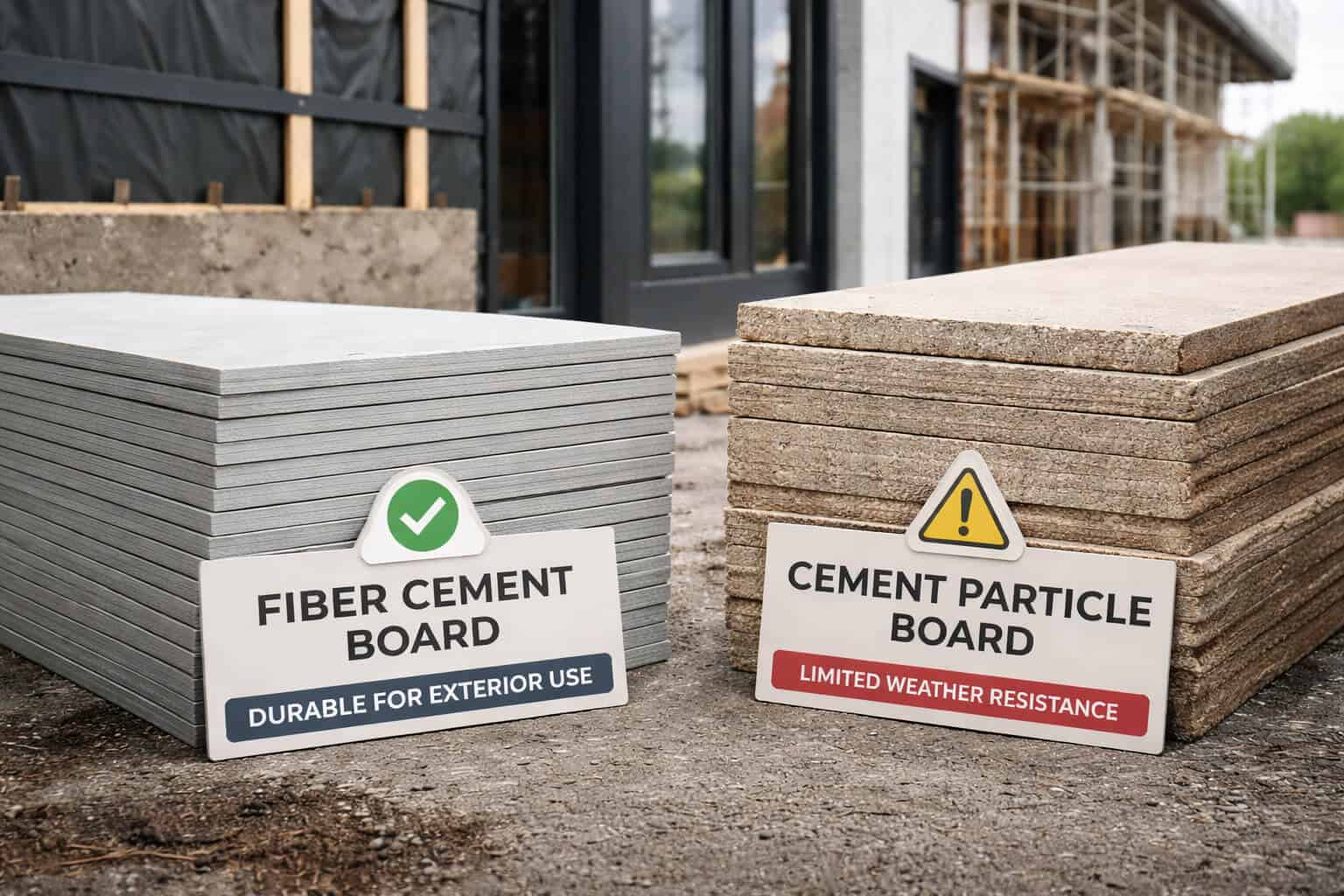
When comparing fiber cement board vs cement particle board, exterior performance is one of the most important questions. Both boards can be used in construction. Both contain cement. Both can be used in demanding environments. But that does not mean they perform equally well when the application moves outdoors. Current European standards show that fibre-cement flat sheets are specifically covered for internal and external wall and ceiling finishes under EN 12467, while cement-bonded particleboards under EN 634-2 are specified for use in dry, humid, and external conditions.
In many cases, fiber cement boards perform better in exterior applications. That is especially true when the project involves façade systems, exterior sheathing, cladding support, changing weather conditions, or a stronger need for long-term confidence. Cement particle boards may still be used in some external situations, but fiber cement boards are often seen as the more suitable and more specification-friendly option for outdoor use. Manufacturer guidance for exterior fiber-cement systems repeatedly emphasizes weather durability, moisture management, and reduced long-term maintenance in exterior conditions.
Why this comparison matters
Exterior applications are different from protected interior uses. A board used outside may face rain, humidity, temperature changes, wind-driven moisture, and longer-term exposure to movement within the wall build-up. That means buyers should not compare boards only by appearance or price. They should compare them by how confidently they fit the real conditions of the project. EN 12467 is explicitly framed around fibre-cement flat sheets for internal and external finishes, while EN 634-2 confirms cement-bonded particleboards for external conditions but from a broader board-specification perspective rather than a façade-led product identity.
That distinction matters. In exterior construction, the better board is usually the one that feels more natural for the job. Architects and contractors want a board that looks easier to defend, easier to specify, and easier to trust over time. This is one reason why the fiber cement board vs cement particle board comparison often ends in favor of fiber cement when the application is outside. Exterior fiber-cement product pages and system guidance commonly position the material around exposure resistance, moisture management, and long-term durability.
Fiber cement board vs cement particle board in exterior use
In exterior use, both boards may seem acceptable at first. However, the market does not usually treat them in exactly the same way.
Fiber cement boards are strongly associated with façades, cladding systems, weather-exposed wall build-ups, and modern dry construction. They are often chosen because they feel designed for demanding exterior roles. EN 12467 supports that positioning by covering fibre-cement flat sheets intended primarily for internal and external wall and ceiling finishes.
Cement particle boards can also be used in external conditions under EN 634-2. Still, they are more often seen as a broader construction board category rather than the first-choice board for exterior envelope performance. That does not mean they are unusable. It means they often do not create the same level of confidence for façade-led or weather-exposed applications.
Why fiber cement boards often perform better outside
One of the biggest advantages of fiber cement boards is that they often feel more comfortable in exposed environments.
That matters because exterior performance is not only about whether a board can survive outdoors. It is also about how stable, dependable, and low-risk the board feels over time. A board that appears more suited to rain, humidity, and changing weather usually becomes the easier choice for the project team. Manufacturer materials for fiber-cement and exterior cement-board systems repeatedly highlight moisture resistance, weather durability, and suitability for exposed environments.
Fiber cement boards also benefit from a stronger façade identity. They are widely used in cladding, rainscreen-related systems, external sheathing, and similar exterior applications. Because of that, they are often perceived as the more professional and more future-proof option when the building envelope matters. EN 12467’s scope supports this by directly covering internal and external wall and ceiling finishes.
Moisture changes the decision
Moisture is one of the biggest reasons why fiber cement boards are often preferred in exterior applications.
Outdoor wall systems are rarely exposed to perfect conditions at all times. There may be rain during construction. There may be changing humidity levels. There may be vulnerable details around openings, joints, and transitions. In these situations, project teams usually want a board that gives them more reassurance, not less. Exterior system guidance from brands such as Nichiha and Knauf emphasizes moisture management, weather exposure performance, and robust substrates for wet, humid, and exposed environments.
This is where fiber cement boards often move ahead. They are commonly seen as the stronger option where the project team wants a board that feels more naturally aligned with exposure-related conditions. Cement particle boards may still be used externally, but they can create more hesitation when the buyer wants the most comfortable answer for long-term outdoor performance. EN 634-2 confirms external use for cement-bonded particleboards, but the broader market and manufacturer positioning around exterior envelope applications is often stronger for fibre-cement systems.
A better fit for façade systems
Another reason fiber cement boards perform better in exterior applications is their stronger fit with façade thinking.
Façades are visible. They are exposed. They are performance-sensitive. They also sit at the center of many questions about durability, weather resistance, fire, maintenance, and long-term confidence. Because of this, specifiers often prefer a board that feels fully at home in the building envelope. Fibre-cement flat sheets are explicitly standardized for external wall finishes, and major fiber-cement brands market their products around exterior siding, cladding, and weather performance.
Fiber cement boards usually fit that expectation better. They are not just construction boards that can be placed outside. They are often selected because outside is exactly where they are expected to perform.
That difference is powerful. In many projects, a material does not win because the alternative is impossible. It wins because it feels more appropriate, more proven, and easier to trust.
Long-term confidence matters
Exterior materials are chosen for more than day-one performance. They are chosen for how they will feel after seasons of weather, site movement, and real use.
That is why long-term confidence matters so much.
Fiber cement boards are often favored because they create a stronger sense of durability and lower maintenance over time. Exterior fiber-cement marketing and product guidance consistently emphasize durability, low maintenance, and resistance to moisture, rot, pests, and weathering.
Even if a buyer first compares boards by cost, the decision often changes once long-term exterior reliability enters the conversation. A board that feels safer and more stable outdoors can easily become the better value, even if the starting price is not the only attraction.
Why cement particle boards can feel more limited outside
Cement particle boards still have a place in construction. They may be suitable in some external applications, especially where the system is already proven and the project team is comfortable with that route. EN 634-2 clearly allows for use in external conditions.
However, in exterior-focused comparisons, they often feel more limited than fiber cement boards.
Why?
Because specifiers and contractors often want the board that creates the fewest doubts. In an outdoor setting, that usually means a board with a stronger façade reputation, a stronger moisture story, and a stronger sense of long-term exposure confidence. Fiber cement boards usually offer that more clearly than cement particle boards. Current product and system materials for exterior fibre-cement solutions repeatedly reinforce that exterior-focused identity.
Price should not be the only measure
It is easy to compare exterior boards by upfront cost. But that can be misleading.
A lower-cost board is not always the better choice if it creates more hesitation, more specification risk, or less confidence in outdoor performance. Exterior applications involve more variables than interior uses. Weather, moisture, detailing, movement, and maintenance all matter.
That is why many project teams prefer to focus on suitability first and price second. In that kind of comparison, fiber cement boards often come out ahead because they feel more tailored to the realities of outdoor use. Manufacturer guidance around exterior fiber-cement products repeatedly frames them as durable, low-maintenance, weather-resistant solutions.
When cement particle boards may still be used
To keep the comparison fair, cement particle boards may still be used in some exterior situations. They are not irrelevant, and the standard does cover external conditions.
But this article is not asking whether they can ever be used outside.
It is asking which board performs better in exterior applications.
And in many real-world cases, the answer is fiber cement board.
That is because the decision is not only about minimum acceptability. It is about which board feels more reliable, more suitable, and more specification-friendly once the project moves outdoors.
The practical conclusion
So, in the fiber cement board vs cement particle board comparison, which performs better in exterior applications?
In many cases, fiber cement board performs better.
It is often the stronger option for:
- exterior sheathing
- façade backing
- cladding support
- weather-exposed wall systems
- projects where long-term confidence matters
Cement particle boards may still be used in some external conditions. However, when the project team wants a board that feels more natural for exterior use, more reassuring in moisture-related situations, and more comfortable within façade-led design, fiber cement boards usually move ahead.
That is why, for many exterior applications, they are not just an alternative.
They are the preferred choice.
Exterior performance is only one part of the decision. For a wider material comparison, including composition, fire rating, surface quality, moisture behavior, and typical application areas, read our full guide on fiber cement board vs cement particle board.
👉 Visit the Smartfiber Fiber Cement Board page to explore specs, sizes, and delivery options.
Authored by Smartcon Int’l. Trade & Marketing Ltd. on 18.04.2026. All rights reserved.
Technical enquiry
Need a board for a demanding construction application?
Share the build-up, exposure, dimensions and performance requirements. We can help assess the appropriate cement-bonded board and supply route.