
Blog
Fiber Cement Board vs Cement Particle Board: Which Handles Moisture More Reliably?
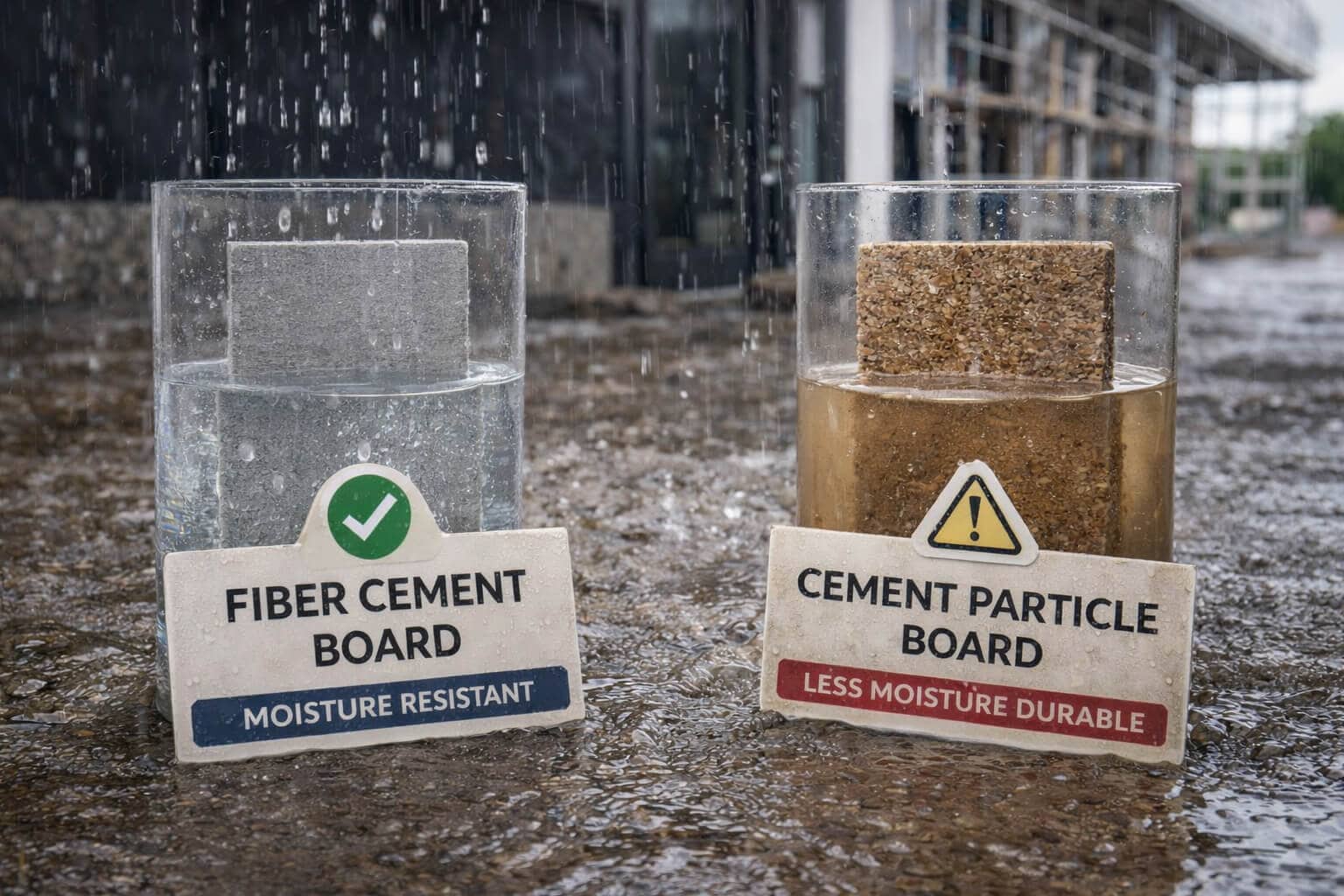
When comparing fiber cement board vs cement particle board, moisture is one of the most important issues to consider. A board may look strong and solid on day one. However, exterior exposure, wet conditions, and long-term humidity can change the decision very quickly. That is why moisture performance matters so much in real construction projects. European standards also frame the two products slightly differently: fibre-cement flat sheets are specifically standardized for internal and external wall and ceiling finishes under EN 12467, while cement-bonded particleboards under EN 634-2 are specified for use in dry, humid, and external conditions.
In many cases, fiber cement boards handle moisture more reliably. This is especially true when the project involves façade systems, exterior sheathing, wet zones, or wall build-ups where long-term exposure confidence matters. Cement particle boards may still be used in humid and external conditions, but fiber cement boards are often seen as the more reassuring and more specification-friendly option when moisture becomes a serious concern. Current manufacturer guidance for cement-board and fiber-cement systems repeatedly emphasizes water resistance, moisture durability, and suitability for interior or exterior applications exposed to moisture.
Why moisture matters so much
Moisture is one of the most common causes of long-term building problems. It affects finishes, joints, fixings, substrates, and the overall confidence of the wall build-up. Even a board that seems acceptable on paper can feel much less convincing if the project team expects repeated exposure to humidity, rain during construction, splash zones, or demanding façade conditions.
This is why buyers should not compare these boards only by density or price. They should compare them by how comfortable they feel in real moisture-related conditions. In practice, the board that creates fewer doubts often becomes the stronger choice. That is a big reason why the fiber cement board vs cement particle board comparison often moves in favor of fiber cement once moisture enters the conversation.
Fiber cement board vs cement particle board in humid and wet conditions
At first glance, both materials may appear suitable for damp or external use. That is partly true. The EN 634-2 standard clearly states that OPC-bonded cement particleboards are specified for use in dry, humid, and external conditions. At the same time, EN 12467 covers fibre-cement flat sheets intended for internal and external wall and ceiling finishes, which supports their strong link to weather-exposed and moisture-sensitive applications.
The difference is not that one board can face moisture and the other cannot. The difference is that fiber cement boards are usually perceived as the more moisture-comfortable option in demanding applications. That matters because in real projects, perception and confidence play a major role in specification decisions.
Project teams often ask a simple question:
Which board feels safer in the long run?
In many cases, the answer is fiber cement board.
Why fiber cement boards often feel more reliable around moisture
One reason fiber cement boards often perform better in moisture discussions is their stronger identity in exterior and wet-duty applications.
Fiber cement and cement-board systems are widely marketed for uses where moisture resistance matters. USG states that its Durock cement board is warranted for interior and exterior application and describes it as water durable and mold resistant. Knauf describes AQUAPANEL Cement Board Universal as a water-resistant building panel. Those kinds of product claims reinforce the broader market view that cement-board and fibre-cement categories are strongly associated with wet and exposed conditions.
That is important.
A board does not only need to survive moisture. It also needs to make the architect, contractor, and developer feel comfortable using it in a moisture-sensitive setting. Fiber cement boards often do that better because they are more strongly associated with façade systems, external wall applications, and demanding wet conditions.
Moisture reliability is not only about water resistance
Many buyers make the mistake of reducing the moisture discussion to one simple question:
“Is the board water resistant?”
That question matters, but it is not enough.
Real moisture reliability is about more than basic resistance. It is also about how the board fits into the whole project. Can it sit more comfortably in a façade build-up? Does it inspire more confidence around weather exposure? Does it feel like the more natural choice for an application where moisture may become a recurring issue?
This is where fiber cement boards often move ahead.
They are commonly seen as boards that belong in moisture-sensitive applications, not just boards that might tolerate them. That distinction is subtle, but it is powerful. It changes how people specify. It changes how they compare products. And it often changes which board they trust more.
A stronger fit for exterior wall systems
Moisture becomes even more important when the application is outside.
Exterior wall systems are exposed to rain, humidity, changing temperatures, and site conditions that are rarely perfect. That is why a board used outside should feel fully at home in that environment. Fibre-cement flat sheets under EN 12467 are explicitly standardized for internal and external wall and ceiling finishes, which supports their strong fit for exposed envelope applications.
Fiber cement boards often benefit from that stronger façade and exterior identity.
They are widely associated with cladding support, façade backing, external sheathing, and modern dry construction. Because of that, they tend to feel more natural in moisture-sensitive exterior use.
Cement particle boards can also be used in external conditions under EN 634-2. Some manufacturer literature also presents them for internal or external applications in dry or humid conditions. CETRIS, for example, describes its cement-bonded particleboards as suitable for internal or external applications in dry or humid conditions, depending on thickness and use.
Still, when the project team wants the board that creates more confidence rather than less, fiber cement boards often remain the preferred option.
Why cement particle boards can create more hesitation
Cement particle boards are not irrelevant in moisture discussions. They can still be suitable in some systems, and the standard clearly includes humid and external conditions.
However, in more demanding moisture-related applications, they often create more hesitation than fiber cement boards.
Why?
Because specifiers usually do not want the board that is merely acceptable. They want the board that feels stronger, safer, and more comfortable in the application. In wet areas, exposed wall systems, or outdoor assemblies, fiber cement boards often create that stronger feeling.
This is not just about technical compliance. It is also about decision confidence.
A board can lose a specification even if it is not technically impossible to use. It may lose simply because the alternative feels more suited to the project. That is often what happens here.
Wet areas and moisture-prone environments
This comparison is also highly relevant in wet interior applications.
Bathrooms, service areas, utility spaces, wet rooms, and other high-humidity zones require boards that create confidence. USG’s system guidance says that where the wall is exposed to moisture, a moisture-resistant barrier should be used behind the cement board. That kind of guidance shows how seriously moisture must be managed in system design, even when the board itself is moisture-durable.
That point helps fiber cement boards as well.
They are often discussed in a more complete moisture-performance context. They are not just sold as boards. They are sold as parts of systems meant to perform in wet, humid, or exposed conditions. This tends to make them easier to specify when moisture is a known design issue.
Long-term confidence matters more than day-one cost
It is easy to compare boards by initial price. However, that can be the wrong way to think about moisture-related performance.
Moisture problems rarely announce themselves at the point of purchase. The real question is what happens later. What happens after exposure? What happens after repeated humidity? What happens when the project team wants confidence that the board choice will not become a source of regret?
This is one reason why fiber cement boards often win the comparison.
They create a stronger sense of long-term reliability. Manufacturer literature for water-resistant cement boards and exterior fibre-cement systems repeatedly emphasizes durability in wet or exposed environments, which supports that broader market perception.
When long-term confidence becomes the priority, fiber cement boards often feel like the safer answer.
When cement particle boards may still be used
To keep the comparison fair, cement particle boards may still be used in some humid or external conditions. The relevant European standard does allow for that, and manufacturers such as CETRIS do present their boards for dry, humid, and external applications within defined conditions.
But this article is not asking whether cement particle boards can ever face moisture.
It is asking which board handles moisture more reliably.
And in many practical, specification-led, and confidence-driven situations, the answer is fiber cement board.
That is because the better board is often the one that feels more naturally suited to moisture-sensitive applications, more reassuring in exterior use, and more comfortable in wet-duty construction environments.
The practical conclusion
So, in the fiber cement board vs cement particle board comparison, which handles moisture more reliably?
In many cases, fiber cement board handles moisture more reliably.
It is often the stronger option for:
- exterior wall systems
- façade backing
- cladding support
- wet areas
- humid environments
- projects where long-term moisture confidence matters
Cement particle boards may still be used in some humid and external situations. However, when the project team wants the board that feels more dependable, more specification-friendly, and more naturally suited to moisture-related challenges, fiber cement boards usually move ahead.
That is why, in many real-world projects, they are not just an alternative.
They are the preferred choice.
Moisture resistance is an important part of board selection, but it should not be reviewed alone. To compare both materials more broadly, including fire performance, exterior suitability, composition, and application differences, read our detailed fiber cement board vs cement particle board article.
👉 Visit the Smartfiber Fiber Cement Board page to explore specs, sizes, and delivery options.
Authored by Smartcon Int’l. Trade & Marketing Ltd. on 18.04.2026. All rights reserved.
Wet-area specification
Need a board for a wet-area application?
Share the substrate, waterproofing, tile and installation requirements. We can help assess the appropriate backer-board specification.