
Blog
Can Fiber Cement Boards Replace Cement Particle Boards in More Demanding Applications?
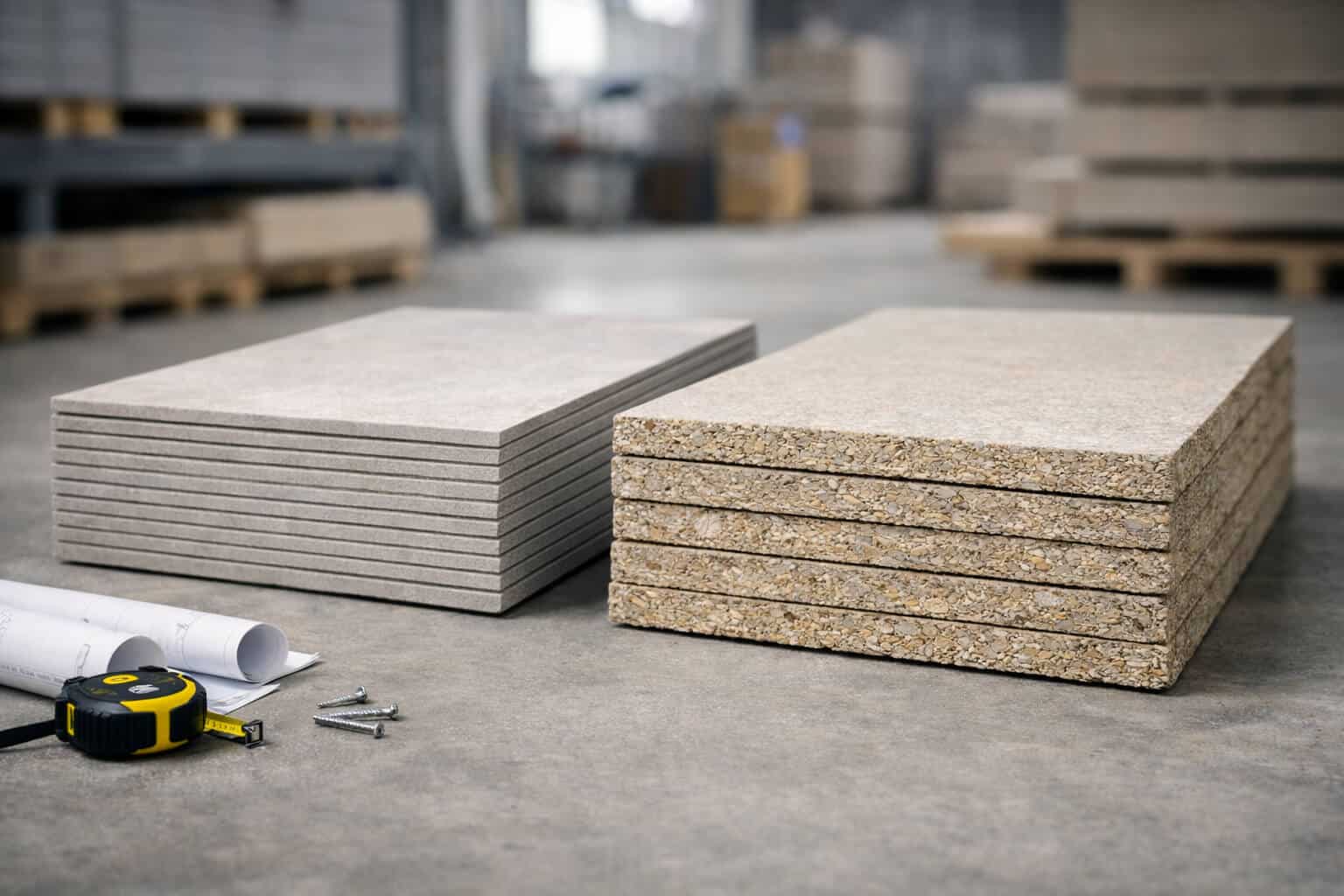
In many cases, yes. Fiber cement boards can replace cement particle boards in more demanding applications, and in fact, they are often the more suitable option when the project requires stronger performance, greater durability, and more confidence over time.
This does not mean cement particle boards have no place in construction. They do. They can still be used in certain protected, lower-risk, or more cost-driven applications. But the moment the application becomes more exposed, more performance-sensitive, or more dependent on long-term reliability, the discussion changes. At that point, the question is no longer simply whether a board can be used. The real question becomes: which board is the safer, more dependable, and more specification-friendly choice for the job?
In many demanding applications, that answer increasingly points toward fiber cement boards.
Why this comparison matters
At first glance, these two materials may appear similar to some buyers. Both contain cement. Both are rigid boards. Both can be used in building systems. Because of this, they are sometimes placed in the same mental category and compared mainly on price.
That is where many wrong decisions begin.
In real construction projects, especially demanding ones, a board is not judged only by what it is made of. It is judged by how confidently it performs in the actual environment where it will be installed. It is judged by how well it handles moisture, weather exposure, dimensional stability, fixing conditions, fire-related expectations, and the pressures of long-term use. It is also judged by how comfortable architects, contractors, and developers feel when specifying it.
This is why a simple price comparison often tells only a small part of the story.
A cheaper board is not necessarily a better board if it creates more uncertainty, more site risk, more limitations, or more hesitation during specification. In more demanding applications, decision-makers are not only buying a sheet material. They are buying performance, predictability, and peace of mind.
That is exactly where fiber cement boards often stand out.
What do we mean by “more demanding applications”?
Not every project is equally challenging. Some uses are relatively simple and protected. Others place much greater demands on the board and on the overall wall build-up.
A demanding application may involve:
- exterior wall build-ups
- ventilated façade systems
- cladding backing or support layers
- modular or offsite construction
- wet-area or moisture-prone environments
- public, commercial, or multi-unit buildings
- projects with stronger fire-performance expectations
- long-term exposure to changing site or weather conditions
- situations where lower maintenance and fewer surprises matter
In these situations, the board needs to do more than just “fill a layer” within the system. It needs to contribute to the confidence of the whole build-up.
That is why many specifiers and contractors prefer fiber cement boards once the application becomes more demanding.
Fiber cement boards are often better suited to exposed uses
One of the clearest reasons fiber cement boards are favored in demanding projects is their strong fit with exterior and envelope-related applications.
Fiber cement boards are widely associated with façade systems, external sheathing, cladding support, and dry construction methods where durability and exposure resistance matter. They are often selected not simply because they can work, but because they feel more naturally aligned with the type of job being done.
This distinction is important.
In demanding projects, people rarely want to specify a material that feels like a compromise. They want a board that belongs in that application. They want a board that feels appropriate, reliable, and easier to defend if questions arise later.
That is one reason fiber cement boards are often seen as the stronger choice in exterior wall systems, ventilated façades, and projects where the wall build-up is expected to perform consistently over time.
Moisture and site exposure change the conversation
Moisture is one of the biggest reasons why boards are re-evaluated.
In theory, many boards may seem acceptable on paper. In practice, construction projects are not always neat, dry, and controlled. Materials may sit on site. Weather conditions may change. Installation may take place in less-than-perfect circumstances. Some parts of the building may face splash zones, humid interiors, or prolonged exposure to varying conditions.
This is where decision-makers often begin to move away from cement particle boards and lean more toward fiber cement boards.
Why?
Because in more demanding or moisture-sensitive environments, buyers usually want a board that feels more robust, more comfortable in exposure-related conditions, and less likely to create long-term doubts. They do not want to spend the life of the project wondering whether the material was just acceptable, or whether a better option should have been chosen from the start.
Fiber cement boards often create more confidence in this respect. They are commonly perceived as a more dependable option where moisture behavior, exterior use, or variable site conditions are part of the equation.
That perception matters, because in construction, confidence is not a soft factor. It directly affects buying decisions.
Fire-conscious applications push specifiers toward safer-feeling choices
Another reason fiber cement boards often replace cement particle boards in more demanding projects is the growing importance of fire-related thinking.
Today, architects, developers, consultants, and contractors are under more pressure than ever to think carefully about the materials used in wall build-ups, façades, and dry construction systems. Even when a product is technically acceptable in certain situations, decision-makers increasingly prefer materials that create a stronger sense of safety and compliance confidence.
This does not mean every project is governed by the same regulations or the same fire-performance requirements. It does mean that the market is becoming more sensitive, more cautious, and more risk-aware.
In that environment, fiber cement boards often feel like the more defensible and future-oriented choice.
That matters a great deal commercially. A material does not only need to perform. It needs to be easy to justify. It needs to support the architect’s decision, reassure the contractor, and reduce hesitation on the developer’s side.
In demanding applications, that kind of confidence is valuable. And it is one of the main reasons fiber cement boards are increasingly preferred.
Long-term reliability matters more than short-term savings
A common mistake in construction purchasing is to focus too much on the initial board price and too little on the overall project risk.
A board that is slightly cheaper at the beginning may not be the better option if it creates greater uncertainty later. If it is less suitable for exposure, less comfortable in demanding conditions, or less convincing to the specifier, then the apparent saving can become less meaningful.
This is especially true in façade and sheathing-related applications, where the board is part of a larger system and where performance over time matters more than the lowest invoice on day one.
The truth is simple: in demanding applications, buyers are rarely looking only for a board that can work. They are looking for a board that reduces the chance of future problems, reduces arguments on site, and supports long-term confidence in the build-up.
That is one of the strongest arguments in favor of fiber cement boards.
They often give the impression of being the more stable, more reliable, and more future-proof choice. For many decision-makers, that makes them worth the preference.
Specification confidence is a major advantage
In many projects, technical performance is only part of the picture. The rest is about specification confidence.
Architects and consultants do not want uncertainty. Contractors do not want avoidable site headaches. Developers do not want callbacks, disputes, or premature issues. Everyone prefers a material that feels easier to approve and easier to defend.
Fiber cement boards often benefit from this mindset.
They are widely recognized in modern façade and dry construction discussions. They are often associated with durable exterior performance, safer wall systems, and more advanced building-envelope use. Because of this, they tend to feel like the more professional and less risky option in demanding situations.
That perception is powerful. Even when two products may look comparable to a non-specialist, the one that creates more confidence will usually win in specification-led projects.
And in demanding applications, fiber cement boards often create more of that confidence.
Does this mean cement particle boards should never be used?
No. That would be too simplistic and not professionally fair.
Cement particle boards may still be suitable in some applications, especially where conditions are more protected, system demands are lower, or budget pressure is the main concern. In certain uses, they may perform adequately and may continue to be selected for practical reasons.
But that is not the main point of this discussion.
The point is that once the application becomes more demanding, the tolerance for compromise becomes lower. Buyers become more careful. Specifiers become more selective. Site teams become less interested in “good enough” and more interested in materials that give them confidence.
That is where the balance often shifts.
So the message is not that cement particle boards have no role. The message is that fiber cement boards are often the better choice when the project asks more from the material.
The practical conclusion
So, can fiber cement boards replace cement particle boards in more demanding applications?
Yes, in many cases they can — and often they should.
When the application involves exterior exposure, façade backing, modular systems, wet-area use, stronger fire-related expectations, or a greater need for long-term reliability, fiber cement boards are often the more suitable option.
The advantage is not only technical. It is also practical and commercial.
Fiber cement boards often provide:
- more confidence in exposed applications
- stronger comfort in demanding environments
- a safer-feeling position in fire-conscious projects
- better long-term reassurance for specifiers and contractors
- a more professional and defensible choice where performance matters
In simpler or more protected situations, cement particle boards may still be considered. But when the project becomes more demanding, more exposed, or more sensitive to long-term performance, fiber cement boards usually move ahead as the more reliable and specification-friendly solution.
And that is why, in many real-world projects, they are not just an alternative.
They are the upgrade.
If you are still comparing both materials at a broader level, you may also find our full guide on fiber cement board vs cement particle board useful before making a specification decision.
👉 Visit the Smartfiber Fiber Cement Board page to explore specs, sizes, and delivery options.
Authored by Smartcon Int’l. Trade & Marketing Ltd. on 18.04.2026. All rights reserved.
Technical enquiry
Need a board for a demanding construction application?
Share the build-up, exposure, dimensions and performance requirements. We can help assess the appropriate cement-bonded board and supply route.