
Blog
How to Choose the Right Fiber Cement Board Thickness for Each Application
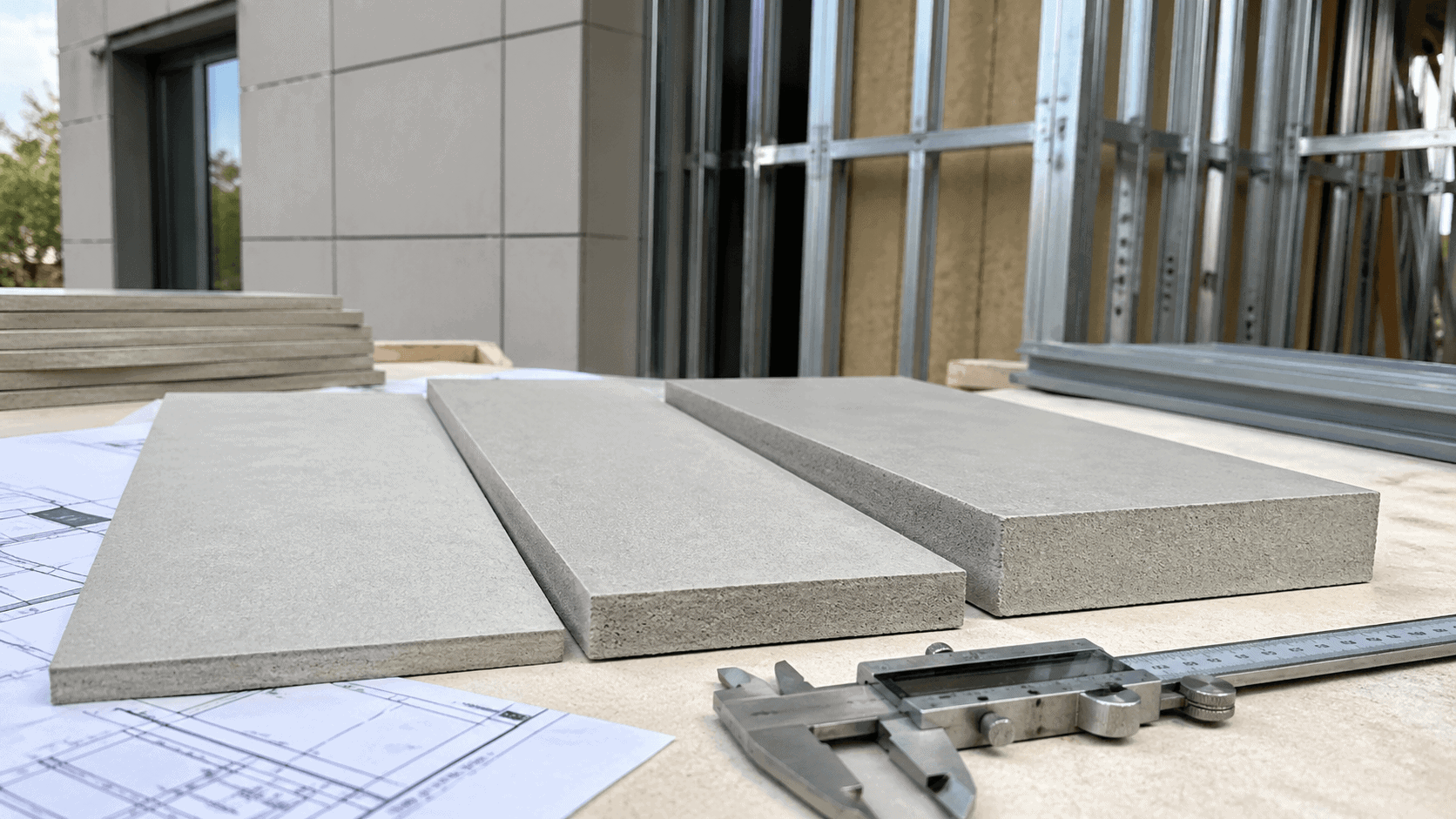
Choosing the right fiber cement board thickness is one of the most important decisions before ordering or installing boards.
Many buyers know they need fiber cement boards. But they are not always sure whether to choose 6mm, 8mm, 10mm, 12mm, or thicker boards.
This decision should not be based only on price. It should be based on the application, fixing method, support structure, exposure level, and expected performance of the board.
A thinner board may be suitable for some backing or lining applications. A thicker board may be better for areas that need higher strength, impact resistance, or more stability.
In this guide, we explain how to choose the right fiber cement board thickness for different construction uses.
Why Fiber Cement Board Thickness Matters
Fiber cement boards are used in many different areas of construction. They can be used as external sheathing, façade backing boards, internal wall boards, ceiling boards, partition boards, wet-area boards, and flooring substrates.
However, not every thickness is suitable for every application.
The right board thickness can help improve:
- Stability
- Fixing performance
- Impact resistance
- Moisture resistance
- Fire-safe construction
- Surface flatness
- Long-term durability
The wrong thickness may cause problems during installation or use. These problems can include board movement, cracking, weak fixing, visible deflection, or poor impact resistance.
That is why a clear fiber cement board thickness guide is useful before specifying or buying the material.
Common Fiber Cement Board Thicknesses
Fiber cement boards are commonly available in several thicknesses. The most widely used options are usually:
- 6mm
- 8mm
- 10mm
- 12mm
- 16mm
- 18mm
- 20mm
Not all manufacturers produce every thickness. Availability may also depend on board size, density, application, and country.
In most building envelope and sheathing applications, 6mm, 8mm, and 10mm fiber cement boards are among the most common choices.
Thicker boards such as 12mm, 16mm, 18mm, and 20mm are usually preferred for more demanding applications, such as flooring, high-impact areas, or stronger substrate requirements.
6mm Fiber Cement Board: Where Is It Used?
A 6mm fiber cement board is usually selected when a lightweight and practical board is needed.
It may be suitable for:
- Internal lining
- Ceiling applications
- Light partition systems
- Backing applications with close support spacing
- Decorative or non-load-bearing uses
- Areas where low weight is important
A 6mm board can be easier to handle and cut. It may also reduce the total weight of the system.
However, it is not always the best option for demanding external applications. If the support spacing is wide, or if the board will face impact, movement, or strong wind loads, a thicker board may be safer.
When to be careful with 6mm boards
A 6mm board should be used carefully when:
- The board is installed outdoors
- The support frame is not close enough
- Higher impact resistance is required
- The board will be used behind heavy finishes
- The surface must remain very flat over time
In short, 6mm can be useful, but it should not be selected only because it is lighter or cheaper.
8mm Fiber Cement Board: A Practical All-Round Option
An 8mm fiber cement board is one of the most practical options for many construction uses.
It often provides a good balance between weight, strength, handling, and installation performance.
It may be suitable for:
- External sheathing
- Façade backing boards
- Rainscreen façade systems
- Partition walls
- Dry construction systems
- Wet-area backing boards
- General wall lining applications
For many projects, 8mm is a strong starting point. It is thick enough for many board applications, but still manageable on site.
This is why 8mm fiber cement board is commonly used in external wall and façade-related systems.
10mm Fiber Cement Board: More Strength and Stability
A 10mm fiber cement board is often selected when higher strength, better stability, or improved impact resistance is needed.
It may be suitable for:
- External wall sheathing
- Façade substrate applications
- High-traffic areas
- More exposed construction areas
- Stronger backing board requirements
- Applications where extra stiffness is preferred
Compared with 6mm or 8mm boards, a 10mm board usually feels more solid. It can also provide better resistance against impact and site handling damage.
However, it is heavier. This means installers must consider lifting, fixing, support spacing, and total system weight.
For many façade and external sheathing applications, 10mm can be a confident and reliable choice when stronger performance is needed.
12mm Fiber Cement Board: When Extra Thickness Is Needed
A 12mm fiber cement board is generally used when the project requires a stronger and more rigid board.
It may be preferred for:
- Heavier-duty wall applications
- Areas with higher impact risk
- Strong substrate applications
- More demanding external systems
- Selected flooring or decking-related build-ups, depending on the full system design
A 12mm board is not always necessary for standard wall sheathing. But it may be useful when the board must provide extra stiffness or support.
The key point is simple: 12mm should be selected for a clear technical reason, not only because “thicker feels better.”
16mm, 18mm, and 20mm Fiber Cement Boards
Thicker fiber cement boards are usually used for more demanding applications.
These may include:
- Flooring substrates
- Raised floor systems
- Heavy-duty dry construction
- Modular construction floors
- High-impact areas
- Special system requirements
These boards are much heavier than standard wall boards. They may require stronger framing, more careful handling, and suitable fixing systems.
For flooring applications, board thickness should always be checked together with the support spacing, expected load, fixing method, and final floor build-up.
A thick board alone does not automatically make a system suitable. The whole system must be designed correctly.
How to Choose Fiber Cement Board Thickness by Application
The best way to choose fiber cement board thickness is to start with the application.
For external sheathing
For external sheathing, 8mm and 10mm boards are commonly preferred.
The final choice depends on:
- Support spacing
- Wind exposure
- Board size
- Building height
- Fixing method
- Cladding system
- Required impact resistance
For many standard external sheathing applications, 8mm can be suitable. For more demanding areas, 10mm may offer extra reassurance.
For façade backing boards
Façade backing boards need to remain stable behind the external finish.
Common choices include 8mm and 10mm.
The correct thickness depends on the façade system. If the board supports additional layers, finishes, or mechanical loads, a thicker board may be needed.
For internal partitions
Internal partitions may use 6mm, 8mm, or 10mm boards depending on the system.
For light-duty internal partitions, 6mm may be enough. For stronger partitions or areas with higher impact risk, 8mm or 10mm may be more suitable.
For ceilings
Ceiling applications usually benefit from lighter boards.
A 6mm board may be suitable in many ceiling systems, depending on the support structure and fixing layout.
However, the board must be properly supported to prevent sagging or movement.
For wet areas
Wet-area backing boards often use 8mm or 10mm boards.
The board thickness should be selected together with the waterproofing system, fixing method, tile finish, and substrate requirements.
Good installation is very important in wet areas. Joint treatment, sealing, and surface preparation must be handled carefully.
For flooring
Flooring applications usually require thicker boards.
Common choices may include 16mm, 18mm, or 20mm boards, depending on the system.
For flooring, thickness selection should never be guessed. The support spacing, expected load, final floor finish, and fixing system must all be considered.
Do Thicker Fiber Cement Boards Always Perform Better?
Not always.
A thicker board may provide more strength and stiffness. But it also adds more weight.
This can affect:
- Handling on site
- Transport cost
- Installation speed
- Frame design
- Fixing requirements
- Labour effort
In some cases, using a thicker board than necessary may increase cost without adding meaningful value.
The best board is not always the thickest board. The best board is the one that matches the application.
Key Factors Before Choosing Board Thickness
Before choosing a fiber cement board thickness, consider the following points.
1. Application area
Is the board used inside or outside? Is it used on a wall, ceiling, façade, or floor?
The application is the first filter.
2. Support spacing
Boards need proper support. Wider support spacing usually requires a thicker or stronger board.
Always check the fixing and support recommendations for the selected board.
3. Exposure level
External boards may face wind, moisture, temperature changes, and site conditions.
More exposed areas may need thicker boards or more careful installation.
4. Impact risk
High-traffic areas need more impact resistance.
A corridor, school, modular unit, or commercial area may require a thicker board than a low-risk internal wall.
5. Final finish
Will the board be painted, tiled, rendered, or used behind cladding?
The final finish can affect the required thickness and surface preparation.
6. Weight and handling
Thicker boards are heavier.
This affects labour, lifting, cutting, fixing, and transport. A practical thickness should balance performance and workability.
7. Fire and moisture requirements
Fiber cement boards are often chosen for fire-safe and moisture-resistant construction.
However, the correct board thickness should still match the system requirements and project specification.
Common Mistakes When Choosing Fiber Cement Board Thickness
Choosing the wrong thickness can create unnecessary problems.
Here are common mistakes to avoid.
Choosing only by price
A thinner board may cost less, but it may not be suitable for the application.
A low initial price can lead to higher costs later if the board cracks, moves, or needs replacement.
Choosing the thickest board without checking the system
Thicker is not always better.
If the frame, fixings, and handling method are not suitable, a thicker board can create new installation problems.
Ignoring support spacing
Board thickness and support spacing work together.
Even a good board can perform poorly if it is not supported correctly.
Using one thickness for every application
A project may require different thicknesses in different areas.
For example, ceilings, walls, external sheathing, and flooring may all need different board specifications.
Forgetting site handling
Thicker boards need more careful handling.
If the team is not prepared, heavy boards may suffer edge damage or installation delays.
Simple Fiber Cement Board Thickness Guide
As a general practical guide:
6mm fiber cement board
Best for lighter internal applications, ceiling systems, and selected backing uses with close support.
8mm fiber cement board
A practical all-round option for wall lining, external sheathing, façade backing, and general dry construction applications.
10mm fiber cement board
A stronger option for external sheathing, façade systems, high-traffic areas, and applications requiring more stiffness.
12mm fiber cement board
Suitable for heavier-duty applications where extra board strength and rigidity are needed.
16mm, 18mm, and 20mm fiber cement boards
Usually preferred for flooring, heavy-duty systems, modular applications, or special construction details.
This guide is general. Final selection should always follow project requirements, system design, manufacturer recommendations, and local regulations.
Final Thoughts
Choosing the right fiber cement board thickness helps make the installation safer, cleaner, and more reliable.
The decision should be based on the application, support spacing, exposure level, impact risk, and final finish.
For many wall and façade applications, 8mm and 10mm boards are practical and reliable choices. For lighter internal uses, 6mm may be suitable. For flooring or heavy-duty systems, thicker boards may be required.
The right board thickness helps reduce site problems and gives architects, contractors, and developers more confidence in the final system. When fiber cement boards are selected and installed correctly, they provide a dependable solution for modern construction.
Thickness selection is also linked to material choice. If you are still deciding between cement particle board and fiber cement board, read our full fiber cement board vs cement particle board comparison before finalizing the specification.
👉 Visit the Smartfiber Fiber Cement Board page to explore specs, sizes, and delivery options.
Authored by Smartcon Int’l. Trade & Marketing Ltd. on 30.04.2026. All rights reserved.
Exterior wall system
Specifying an exterior wall system?
Share the wall build-up, exposure, framing and fire-performance requirements. We can help assess the sheathing specification and next steps.