
Blog
Fiber Cement Board for Modular Construction: Where Thickness and Fixing Matter Most
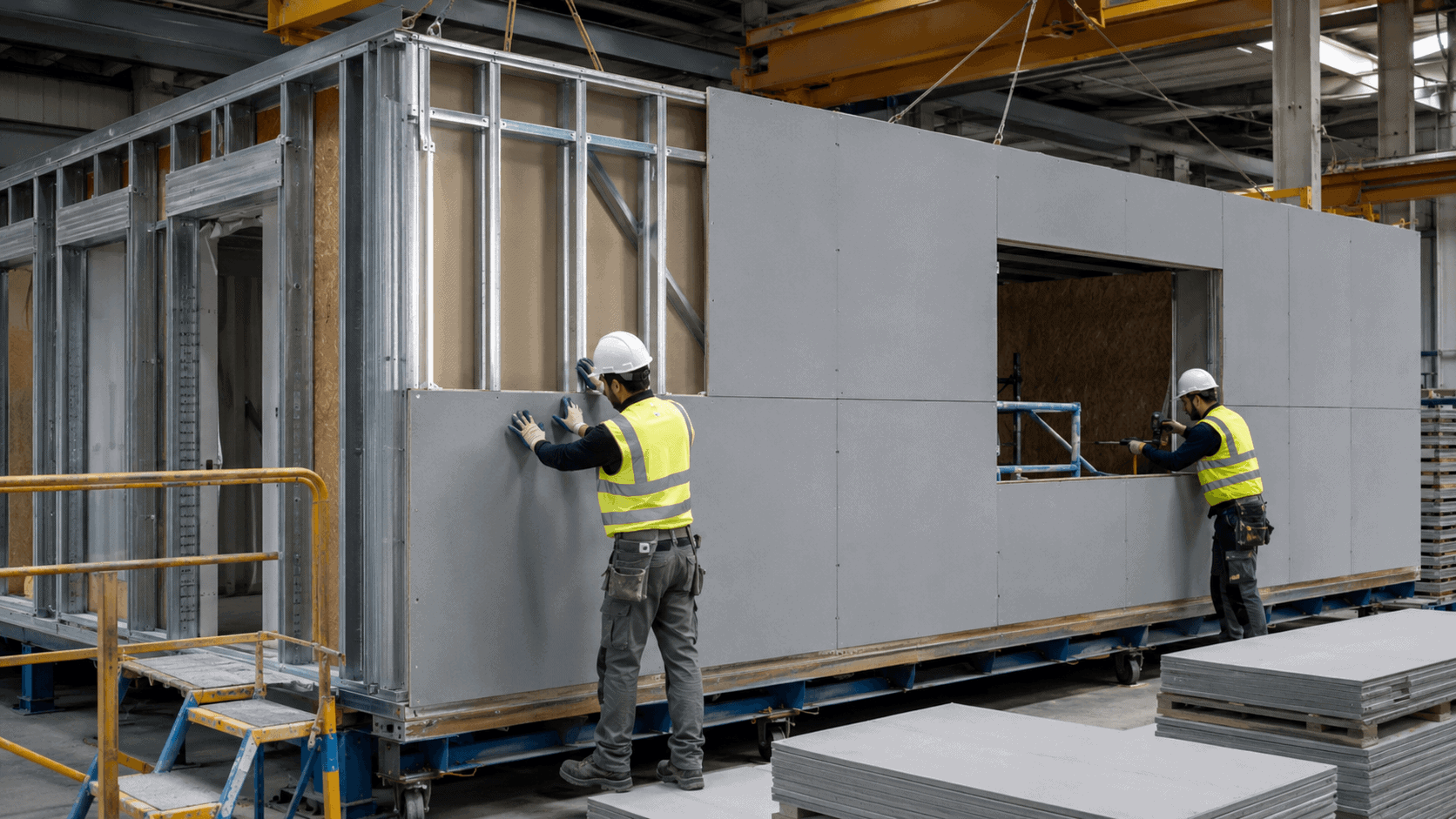
Fiber cement board is a practical material for modular construction because it can support fast installation, dry construction methods, and reliable wall build-ups.
In modular buildings, the wall system must be strong, stable, and easy to assemble. Boards may be used for external sheathing, internal lining, façade backing, wet areas, fire-safe walls, or floor build-ups.
However, modular construction also places extra demands on the board system. The modules are manufactured, moved, lifted, transported, and installed on site. This means board thickness, fixing method, joint planning, and edge protection become especially important.
For specifiers, contractors, and modular building manufacturers, the key point is simple: fiber cement board can work very well in modular construction when the correct thickness and fixing details are selected from the beginning.
Why Fiber Cement Board Is Used in Modular Construction
Modular construction depends on speed, repeatability, and controlled production.
Fiber cement boards are suitable for many modular applications because they can be installed as part of dry wall and floor systems. They can also provide a stable board layer for external or internal construction details.
They may be used in:
- External wall sheathing
- Façade backing
- Internal wall lining
- Partition systems
- Wet-area backing
- Fire-safe wall build-ups
- Floor and ceiling systems
- Prefabricated wall panels
- Lightweight steel frame modules
- Timber frame modular units
The board can help modular manufacturers create consistent wall assemblies in factory conditions.
But the correct specification matters.
Modular Buildings Need Stronger Planning
A modular unit is not built in the same way as a traditional wall on site.
The module may be:
- Manufactured in a factory
- Moved inside the production area
- Lifted by crane
- Loaded onto a truck
- Transported over long distances
- Stored before installation
- Installed and connected to other modules
- Exposed to weather during assembly
These steps can create vibration, movement, impact, and handling stress.
Because of this, the board must be selected and fixed with the full modular process in mind.
A board that looks suitable on paper may still perform poorly if it is too thin, poorly supported, badly fixed, or exposed to damage during transport.
Where Fiber Cement Board Thickness Matters Most
Thickness is one of the most important decisions in modular construction.
The right thickness helps improve:
- Board stiffness
- Fixing strength
- Impact resistance
- Handling performance
- Surface stability
- Transport durability
- Final finish quality
The wrong thickness can lead to cracking, edge damage, movement, surface waves, weak fixing, or problems around joints.
In modular construction, board thickness should be selected according to the application, not only according to material cost.
Common Thickness Choices in Modular Construction
Different thicknesses may be used for different parts of a modular building.
6mm boards
A 6mm fiber cement board may be suitable for lighter internal applications, ceiling boards, or non-demanding backing areas with close support.
It is easier to handle and lighter than thicker boards.
However, it may not be the best choice for exposed external sheathing or areas that face transport stress, impact, or higher loading.
8mm boards
An 8mm fiber cement board is often a practical all-round choice.
It may be suitable for:
- Wall lining
- External sheathing
- Façade backing
- Wet-area backing
- General modular wall systems
For many modular wall applications, 8mm can provide a good balance between weight, workability, and performance.
10mm boards
A 10mm fiber cement board is often preferred when extra stiffness and impact resistance are needed.
It may be suitable for:
- External wall sheathing
- More exposed modular façades
- High-traffic internal areas
- Stronger wall build-ups
- Applications where transport stress is a concern
Compared with 8mm, 10mm may give more reassurance in demanding applications.
12mm and thicker boards
Thicker boards may be required for heavier-duty applications.
These may include:
- Floor build-ups
- High-impact areas
- Stronger wall systems
- Special modular applications
- More demanding structural or substrate requirements
For floors, thickness should always be checked together with support spacing, expected load, fixing method, and the complete floor system.
External Sheathing in Modular Construction
External sheathing is one of the most important uses of fiber cement board in modular buildings.
The external sheathing board may support the wall build-up and provide a stable backing layer for façade systems or protective external finishes.
For external modular walls, check:
- Board thickness
- Support spacing
- Screw spacing
- Wind exposure
- Moisture exposure
- Transport movement
- Edge protection
- Joint treatment
- Final façade system
- Weather barrier position
External sheathing boards must be strong enough for both factory installation and site performance.
The board must also remain stable during transport and lifting.
Fixing Method Is Critical in Modular Construction
Fixing is just as important as thickness.
A good fiber cement board can still fail if it is fixed poorly.
In modular construction, fixings must handle not only normal building use but also production, movement, lifting, transport, and site assembly.
Check the following:
- Correct screw type
- Correct screw length
- Correct screw spacing
- Correct edge distance
- Proper screw head position
- Suitable support frame
- No overdriven screws
- No loose fixings
- No unsupported board edges
- No fixing into weak or unstable framing
The board should be firmly fixed without being damaged.
Overdriven screws can create weak points. Loose screws can allow movement.
Both problems can appear later as cracks or surface defects.
Steel Frame Modules and Fiber Cement Board
Many modular buildings use light gauge steel frames.
Steel frame modular systems can provide accurate and repeatable support for fiber cement boards.
When fixing to steel frame, check:
- Steel profile thickness
- Galvanization or corrosion protection
- Screw compatibility
- Drill point suitability
- Stud spacing
- Frame alignment
- Support behind joints
- Corrosion-resistant fixings
Steel frames can be very suitable for modular production, but the fixings must match the steel profile.
Do not use screws designed for timber unless they are suitable for the steel frame.
Timber Frame Modules and Fiber Cement Board
Timber frame modular systems are also common.
Timber provides strong fixing grip and is easy to work with. However, it must be dry, straight, and stable before board installation.
When fixing to timber frame, check:
- Timber moisture content
- Timber treatment
- Batten or stud straightness
- Screw embedment
- Risk of splitting
- Support spacing
- Ventilation
- Protection from trapped moisture
Timber can move if it becomes wet or unstable. This movement can affect the fiber cement board and final finish.
In modular construction, timber moisture control is especially important because modules may be stored, transported, or temporarily exposed before final installation.
Board Joints Must Be Planned Early
Joint planning is very important in modular construction.
Because modules are repeated, joint positions can be planned in advance. This is a major advantage.
Good joint planning helps improve:
- Installation speed
- Appearance
- Board stability
- Finishing quality
- Movement control
- Weather protection
- Factory repeatability
Board joints should be aligned with proper supports. Unsupported board edges should be avoided.
Joints should also allow for movement, especially in external applications.
Think About Module-to-Module Connections
One special issue in modular construction is the connection between modules.
When modules are placed side by side or stacked, board edges and finishes may meet at module joints.
These areas need careful detailing.
Check:
- Module joint location
- Board edge protection
- Movement allowance
- Fire stopping
- Weather sealing
- External finish continuity
- Internal finish alignment
- Access for final sealing
- Tolerance between modules
The board layout should not make module connections more difficult.
A good design considers how boards will meet after the modules are installed on site.
Transport and Lifting Can Affect Board Performance
Modular units are moved more than traditional walls.
During transport and lifting, modules may face vibration, pressure, temporary movement, and handling risk.
This can affect the board system if it is not properly detailed.
To reduce risk:
- Use suitable board thickness
- Fix boards securely
- Protect corners and edges
- Avoid weak cut-outs near edges
- Support large board areas
- Protect installed boards during transport
- Inspect boards after delivery
- Avoid loading against exposed board faces
Transport damage is easier to prevent than repair.
Protect Board Edges During Production and Transport
Edges and corners are high-risk areas.
They can be damaged during factory handling, stacking, lifting, loading, transport, and site installation.
Good edge protection may include:
- Careful handling
- Protective trims
- Proper stacking
- Corner protection
- Avoiding impact from tools and equipment
- Protecting exposed edges during transport
- Avoiding unsupported overhangs
- Sealing cut edges where required
Damaged board edges can affect the final finish and may create weak points.
Openings and Service Penetrations Need Extra Care
Modular buildings often include pre-planned service openings.
These may be for:
- Pipes
- Cables
- Ducts
- Vents
- External lights
- HVAC units
- Drainage outlets
- Electrical boxes
Openings should be planned before board installation where possible.
Poorly placed openings can weaken the board, especially if they are close to joints, corners, or edges.
For service penetrations, check:
- Opening size
- Edge distance
- Support around openings
- Sealing method
- Fire-stopping requirement
- Acoustic sealing
- Weather protection
- Final finish compatibility
A clean opening is easier to seal and finish than a rough site cut.
Moisture Control During Storage and Transport
Fiber cement boards are often selected because they perform well in demanding construction environments.
However, modular units and board materials should still be protected from unnecessary moisture exposure before installation is complete.
Moisture risks can come from:
- Rain during transport
- Poor temporary storage
- Water trapped between boards
- Open module edges
- Unfinished façade areas
- Wet timber framing
- Poor site drainage
- Damaged wrapping
Good moisture control helps protect the board, frame, insulation, membranes, and final finish.
Modules should be protected during storage and transport, especially before the external wall system is fully closed.
Impact Resistance in Modular Buildings
Modular buildings may be used for schools, hospitals, offices, accommodation, site units, residential projects, and commercial buildings.
Some areas may face more impact than others.
High-risk areas include:
- Corridors
- Entrances
- Stair areas
- Service zones
- Schools
- Healthcare areas
- Public buildings
- Lower external wall areas
- Transport routes during production
In these areas, thicker boards or additional protection may be useful.
Board thickness should be matched to the expected use of the building.
Fire Performance Must Be Considered as a Full System
Fiber cement board is often used in fire-safe wall assemblies.
However, fire performance depends on the full wall system, not only the board.
Specifiers should check:
- Board fire classification
- Board thickness
- Frame material
- Insulation
- Membranes
- Cavity barriers
- Service penetrations
- Joint treatment
- Internal and external finishes
- Module-to-module fire stopping
- Local regulations
In modular construction, fire-stopping at module joints and service penetrations is especially important.
Do not assume one material gives the full building system the required fire performance.
Wet Areas in Modular Construction
Modular buildings often include bathrooms, kitchens, utility rooms, and plant areas.
Fiber cement boards may be used as backing boards in wet or moisture-prone areas.
For wet areas, check:
- Board thickness
- Waterproofing system
- Joint treatment
- Sealant compatibility
- Tile adhesive compatibility
- Pipe penetrations
- Floor-to-wall junctions
- Ventilation
- Cleaning and maintenance exposure
The board should be part of a full wet-area system, not a substitute for waterproofing where waterproofing is required.
Flooring and Floor Build-Ups
Fiber cement boards can be used in some floor build-ups, depending on the system design.
Flooring applications need extra care because they may face load, foot traffic, impact, vibration, and final floor finishes.
For flooring, check:
- Board thickness
- Support spacing
- Expected load
- Deflection limits
- Fixing method
- Joint treatment
- Underfloor heating compatibility
- Acoustic requirements
- Final floor finish
- Manufacturer guidance
Floor build-ups should never be guessed.
A thicker board may be needed, but thickness alone is not enough. The full floor system must be designed correctly.
Common Mistakes to Avoid
Avoid these common mistakes when using fiber cement board in modular construction:
- Choosing board thickness only by price
- Using the same thickness for every application
- Ignoring transport and lifting stress
- Fixing boards to misaligned frames
- Using the wrong screws for steel or timber
- Overdriving screw heads
- Leaving board edges unsupported
- Ignoring module-to-module joints
- Cutting rough service openings after installation
- Forgetting edge protection during transport
- Allowing moisture into unfinished modules
- Ignoring fire-stopping at module joints
- Treating wet areas without a complete waterproofing system
- Using flooring boards without checking full system design
Most problems can be prevented if thickness, fixing, joints, and transport protection are planned early.
Modular Construction Checklist for Specifiers
Before approving fiber cement board for modular construction, check:
- What is the board application?
- Is the board used internally or externally?
- What thickness is required?
- Is the support frame steel or timber?
- Is the support spacing suitable?
- Are the correct screws specified?
- Are board edges fully supported?
- Are joint gaps and movement details included?
- Are module-to-module joints planned?
- Are openings and service penetrations supported?
- Is moisture protection planned during transport?
- Is edge protection required?
- Are wet areas detailed correctly?
- Is fire performance checked as a full system?
- Is the final finish compatible with the board?
This checklist helps reduce risk in both factory production and site installation.
When Fiber Cement Board Works Best in Modular Construction
Fiber cement board works best in modular construction when:
- The correct thickness is selected
- The support frame is flat and stable
- Fixings are suitable for steel or timber
- Board joints are planned in advance
- Module connections are detailed correctly
- Edges are protected during transport
- Moisture exposure is controlled
- Openings are clean and supported
- Fire and acoustic details are checked
- Installation follows manufacturer guidance
In these conditions, fiber cement board can support fast, clean, and reliable modular construction.
Final Thoughts
Fiber cement board can be a strong and practical material for modular construction.
It can be used in external sheathing, façade backing, internal lining, wet areas, fire-safe walls, and selected floor build-ups.
However, modular buildings require more planning than ordinary site-built walls. The boards must be selected and fixed with production, lifting, transport, installation, and long-term use in mind.
Thickness and fixing matter most because they affect board stability, impact resistance, movement control, and final finish quality.
When the board, frame, fixings, joints, and transport protection are planned correctly, fiber cement board can provide a dependable solution for modern modular and offsite construction.
Need pricing, technical documents, or loading guidance for fiber cement boards? Contact Smartcon with your required thickness, dimensions, quantity, and delivery destination. Our team will help you review the suitable options and provide practical export support from Turkey.
👉 Visit the Smartfiber Fiber Cement Board page to explore specs, sizes, and delivery options.
Authored by Smartcon Int’l. Trade & Marketing Ltd. on 08.05.2026. All rights reserved.
Façade specification
Need the right board for your façade system?
Share the façade build-up, exposure conditions, finish and documentation requirements. We can help assess the appropriate board and coordinate supply.