
Blog
Which Side of Fiber Cement Board Should Face Out?
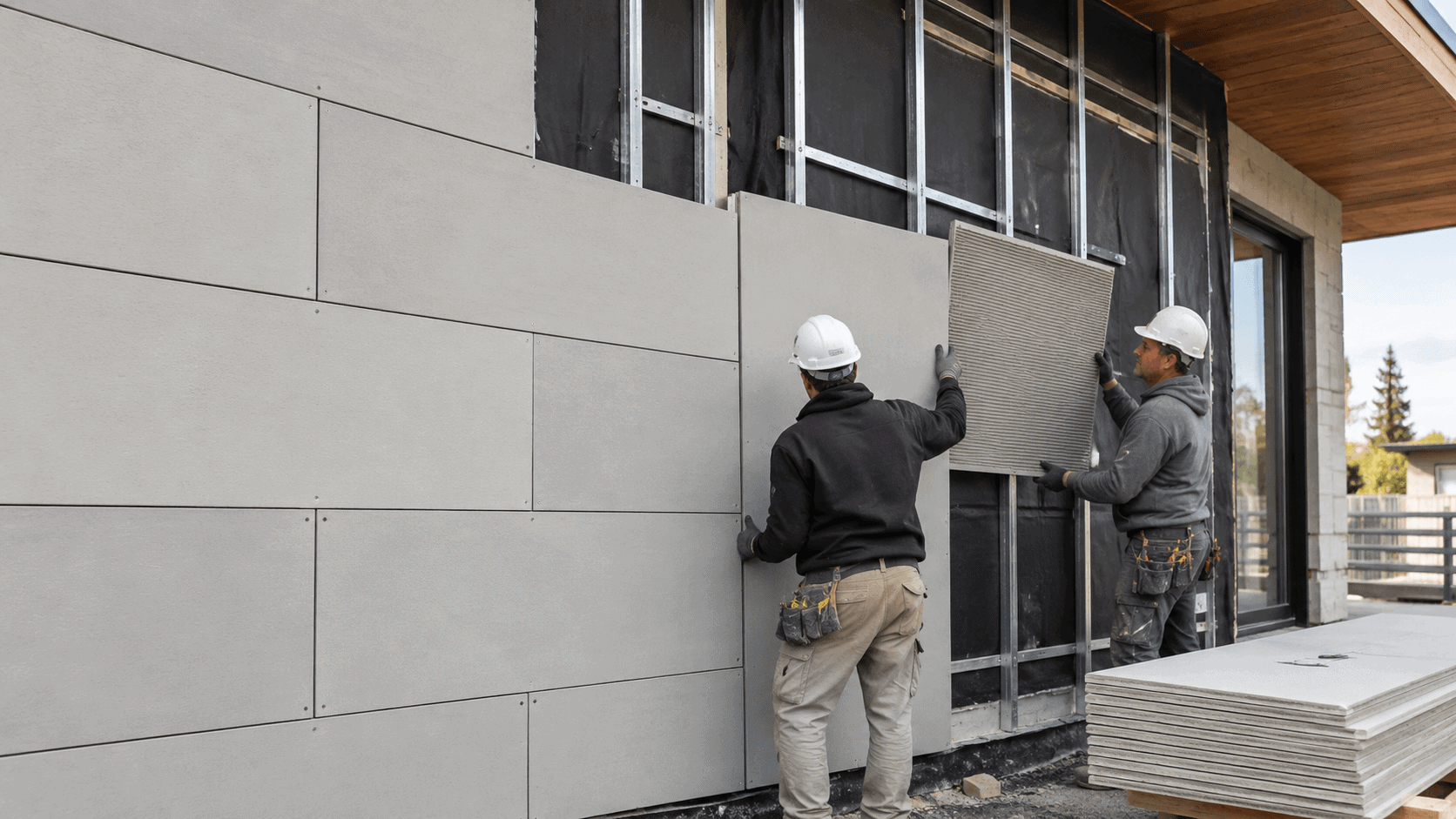
Fiber cement board is a practical and reliable construction board used in façades, external sheathing, partition walls, ceilings, soffits, tile backing, dry construction, and many other building applications.
However, before installation starts, one simple question often comes up on site:
Which side of fiber cement board should face out?
The short answer is: the side that faces out depends on the board type, the final finish, the application, and the manufacturer’s installation guidance.
Some fiber cement boards have two similar faces. Some have one smoother face and one rougher face. Some are designed for painting, coating, tiling, rendering, or hidden sheathing use. For this reason, the correct side should always be checked before fixing the board.
Choosing the correct face matters because it can affect appearance, paint adhesion, tile bonding, render performance, surface flatness, and the final quality of the wall.
This guide explains how to decide which side of fiber cement board should face out in a simple and practical way.
Why Board Direction Matters
The face direction of fiber cement board may look like a small detail, but it can affect the final result.
If the wrong side is exposed, the surface may not look as intended. It may also be more difficult to paint, coat, render, tile, or finish properly.
The correct board side helps with:
- Surface appearance
- Paint or coating quality
- Adhesive bonding
- Render or plaster compatibility
- Tile fixing performance
- Joint treatment
- Final wall flatness
- Long-term finish quality
In hidden applications, the difference may not be very important visually. In visible applications, it can make a major difference.
Check the Manufacturer’s Markings First
The first step is simple: check the board markings, labels, and technical documents.
Some fiber cement boards may have printed markings, batch information, product codes, or installation instructions on one side. These markings may indicate the back side, the fixing side, or simply the production identification side.
Do not assume that printed text always means the same thing for every product. Different manufacturers may use different marking systems.
Before fixing the boards, check:
- Board labels
- Pallet information
- Product datasheet
- Installation guide
- Surface finish information
- Project specification
- Recommended coating or finishing system
If the board has a clear marked face, follow the manufacturer’s guidance. This is the safest approach.
Smooth Side or Rough Side: Which One Should Face Out?
Many fiber cement boards have one smoother side and one slightly rougher side.
In many visible applications, the smoother side is preferred as the exposed face because it gives a cleaner final appearance. It is often easier to paint, coat, or finish neatly.
However, this is not a universal rule for every board and every application.
In some systems, a rougher surface may be preferred for better bonding with render, adhesive, mortar, tile adhesive, plaster, or another finishing layer. In other systems, the smoother side may be used for decorative finishing.
So the real answer is not simply “smooth side out” or “rough side out.”
The correct answer is:
Use the side that matches the final finish and the board manufacturer’s recommendation.
If the Board Will Be Painted
If fiber cement board will be painted, the exposed face should normally be the side suitable for painting.
This is usually the cleaner, more uniform surface. A smoother surface can help create a better painted appearance, especially on visible walls, façades, soffits, ceilings, and interior areas.
Before painting, the surface should be clean, dry, dust-free, and properly prepared. Primer may also be required depending on the board and paint system.
For painted applications, check:
- Which face is recommended for painting
- Whether primer is required
- Whether screw heads need filling
- Whether joints will remain visible or be treated
- Whether edges need sealing
- Whether the surface has dust, stains, or handling marks
Even when the correct side faces out, poor surface preparation can still lead to a poor finish.
If the Board Will Be Rendered or Plastered
If fiber cement board will receive render, plaster, base coat, mesh, or a similar coating system, the correct side may depend on bonding performance.
Some finishing systems need a surface that gives better grip. In these cases, the rougher or more textured side may be preferred, but this must be confirmed with the board and render system guidance.
Do not choose the side by appearance only. A surface that looks smoother may not always be the best bonding surface for render or plaster.
For rendered or plastered systems, check:
- Which board face is recommended
- Whether primer or bonding agent is required
- Whether mesh is needed
- Whether the board joints are treated correctly
- Whether the board is suitable for the render system
- Whether the surface is clean and dry before application
The finish must be compatible with the board. The board face, primer, base coat, mesh, and final render should work together as a complete system.
If the Board Will Be Tiled
When fiber cement board is used behind tiles, the surface facing out should be suitable for tile adhesive or mortar.
This is especially important in bathrooms, kitchens, wet areas, commercial interiors, and backing applications. The wrong surface may reduce bonding quality or make installation harder.
Before tiling, check the board face, adhesive compatibility, waterproofing requirements, and joint treatment.
For tiled applications, check:
- Which side is recommended for tile adhesive
- Whether waterproofing is required
- Whether the area is wet or dry
- Whether the adhesive is compatible with fiber cement board
- Whether joints need tape, filler, or sealant
- Whether the surface is clean and free from dust
Tiling success depends on the full system, not only the board surface.
If the Board Is Used as External Sheathing
In external sheathing applications, fiber cement board is often used as part of a wall build-up behind another layer. It may sit behind insulation, membranes, cladding, render systems, or ventilated façade systems.
In this case, the face direction may be less about appearance and more about system compatibility.
The correct side should support the next layer of the system. This may include membranes, insulation, mechanical fixings, render carrier layers, or cladding support elements.
For external sheathing, check:
- Which face should receive the next layer
- Whether a breather membrane or weather barrier is required
- Whether the board will be visible or hidden
- Whether the surface must bond with another material
- Whether the board edges and joints are protected
- Whether the fixing pattern remains correct
External sheathing should always be treated as part of a complete wall system.
If the Board Will Stay Visible
If fiber cement board will remain visible, the side facing out is very important.
Visible boards may be painted, coated, left with a natural cement appearance, or used as part of an architectural design. In these cases, the exposed face should be the best surface for the intended appearance.
Before installation, inspect the board surface. Look for shade differences, handling marks, surface texture, printed markings, edge damage, and visible defects.
For visible applications, check:
- Which side looks cleaner and more uniform
- Whether the face is suitable for the chosen finish
- Whether screw heads will remain visible
- Whether joints will be part of the design
- Whether the board surface needs primer or coating
- Whether the natural board appearance is acceptable
Do not decide this after installation. Once the boards are fixed, changing the exposed face is not practical.
If the Board Will Be Hidden
If fiber cement board is used in a hidden layer, the face direction may be less critical, but it should still follow the project specification.
Hidden applications may include backing boards, internal build-ups, sheathing layers, service zones, or areas that will be covered by another product.
Even when the board will be hidden, the correct side may still matter for bonding, fixing, moisture control, or compatibility with the next layer.
So the safe rule is the same:
Check the intended build-up and follow the board guidance before fixing.
Do Not Mix Board Directions Randomly
One common installation mistake is mixing board faces randomly on the same wall.
If some boards are installed with the smooth side out and others with the rough side out, the final surface may look uneven. Paint, coating, render, or adhesive may also behave differently across the wall.
This can create visible differences after finishing.
To avoid this problem:
- Check the board face before lifting
- Keep all boards in the same orientation where required
- Train the installation team before work starts
- Mark the exposed side if needed
- Inspect each area before fixing continues
- Do not rely on one installer’s assumption
Consistency is especially important on large walls and façades.
Watch for Printed Text and Production Marks
Some boards may have printed text, stamps, product references, or batch markings on one face.
If the board will be visible or painted with a thin coating system, printed marks may create problems if they face outward. They may remain visible, require extra preparation, or affect the final appearance.
If the board is used behind another finish, markings may not matter visually. However, they may still indicate which side is intended as the back face.
The important point is to check before installation.
Printed side does not always mean “wrong side out,” but it should never be ignored.
Check the Board Surface Before Fixing
Before installing fiber cement boards, inspect the surface that will face out.
Look for:
- Dust
- Moisture marks
- Oil or dirt
- Handling marks
- Edge damage
- Surface scratches
- Printed markings
- Chips or cracks
- Colour variation
- Incorrect face orientation
If a board has visible damage on the face side, do not install it in a prominent area. Use it in a suitable hidden area if allowed, or replace it if necessary.
Good installers check the board before fixing, not after finishing.
Think About the Final Finish Before Installation
The correct board face cannot be separated from the final finish.
A painted wall, tiled wall, rendered façade, ventilated façade, ceiling, soffit, and hidden sheathing layer may all have different surface requirements.
Before fixing the boards, confirm the final finish with the project team.
Ask:
- Will the board be painted?
- Will the board be rendered?
- Will the board be tiled?
- Will the board be covered by cladding?
- Will the board remain visible?
- Will the board be exposed to moisture?
- Will the surface need primer?
- Will the joints be visible or covered?
When the final finish is clear, the correct board face is much easier to choose.
Common Mistakes to Avoid
Do not assume every fiber cement board has the same front and back face.
Do not assume the smooth side is always correct for every application.
Do not assume the rough side is always better for bonding.
Do not mix smooth and rough faces randomly on the same wall.
Do not leave printed markings facing out on visible surfaces unless the finishing system allows it.
Do not choose the board face after the boards have already been fixed.
Do not ignore the final finish when deciding the board direction.
Do not install damaged or stained board faces in visible areas.
These mistakes are easy to avoid with a short pre-installation check.
Practical Site Checklist
Before installation, check the board type, surface condition, and final finish.
Confirm which face is recommended by the board manufacturer or project specification.
Separate boards if one side is visibly better for the exposed face.
Make sure all installers understand which side should face out.
Check each board before fixing.
Keep the board direction consistent across the wall.
Inspect the surface before painting, coating, rendering, tiling, or covering.
This simple checklist can prevent visible defects, poor adhesion, and unnecessary rework.
Final Thoughts
The side of fiber cement board that should face out depends on the board type, surface finish, application, and final wall system.
For visible painted surfaces, the cleaner and smoother side is often preferred. For render, plaster, adhesive, or tile systems, the correct side depends on bonding and system compatibility. For hidden sheathing layers, appearance may be less important, but the board still needs to match the full wall build-up.
The safest rule is simple:
Do not guess. Check the board guidance, final finish, and project specification before installation starts.
Fiber cement boards are dependable and practical when installed correctly. Choosing the correct face direction is a small step, but it helps improve appearance, finishing quality, and long-term performance.
Need pricing, technical documents, or loading guidance for fiber cement boards? Contact Smartcon with your required thickness, dimensions, quantity, and delivery destination. Our team will help you review the suitable options and provide practical export support from Turkey.
👉 Visit the Smartfiber Fiber Cement Board page to explore specs, sizes, and delivery options.
Authored by Smartcon Int’l. Trade & Marketing Ltd. on 02.07.2026. All rights reserved.
Façade specification
Need the right board for your façade system?
Share the façade build-up, exposure conditions, finish and documentation requirements. We can help assess the appropriate board and coordinate supply.