
Blog
How to Protect Fiber Cement Boards from Rain Before Installation
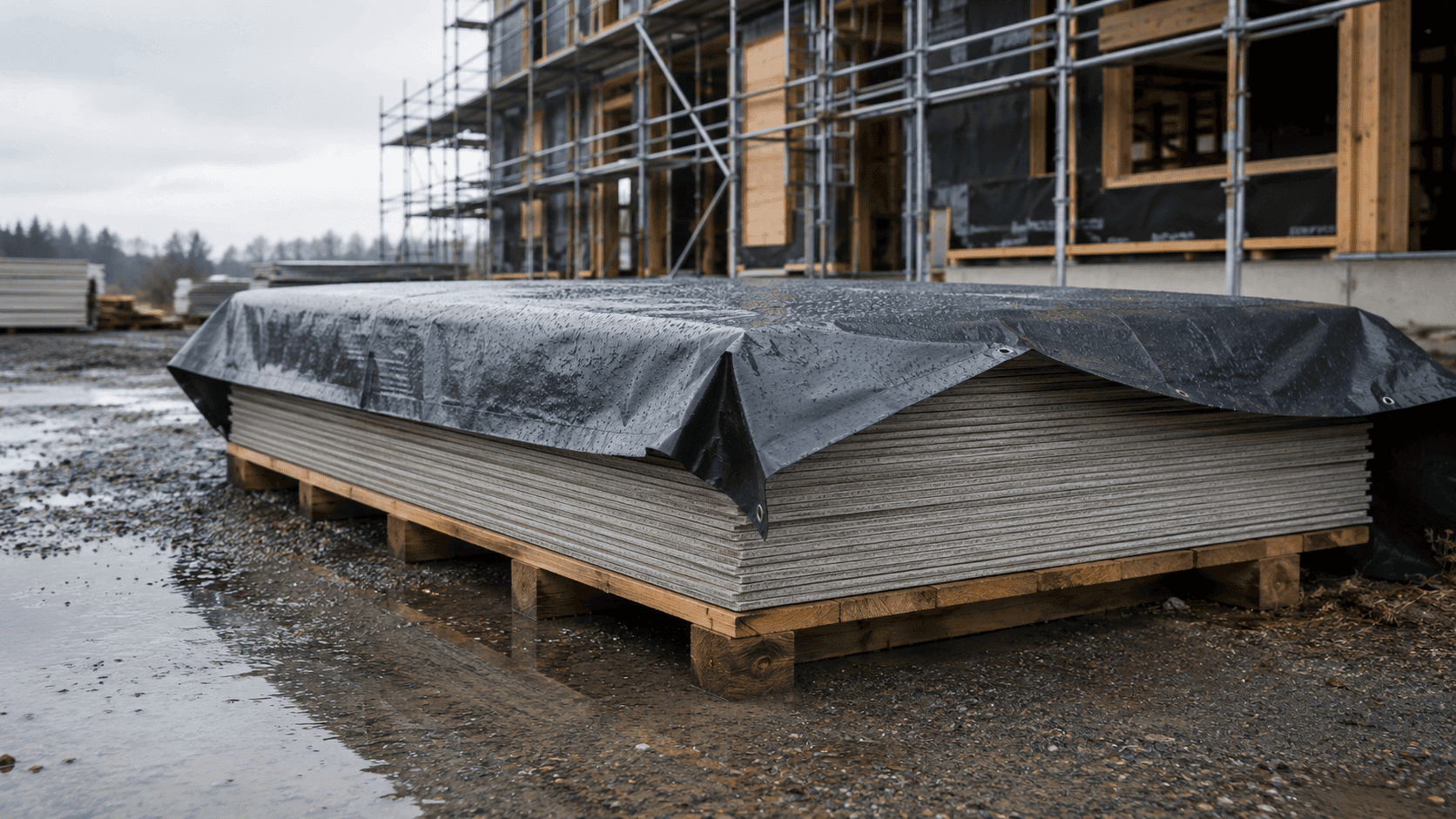
Fiber cement boards are widely used in façades, external sheathing, dry construction, modular buildings, and rainscreen systems. They are known for their durability, dimensional stability, and resistance to moisture when used correctly.
However, this does not mean fiber cement boards should be left exposed to rain on site without protection.
Like many construction boards, fiber cement boards should be stored, handled, and installed properly. Good site protection helps prevent unnecessary surface staining, edge saturation, board movement, installation delays, and finishing problems.
In this article, we explain how to protect fiber cement boards from rain before installation and what to check if boards become wet on site.
Why Rain Protection Matters Before Installation
Fiber cement boards are suitable for demanding construction applications. Still, temporary site exposure is different from correct long-term use within a completed wall or façade system.
Before installation, boards may be stacked on pallets, wrapped, moved by forklift, or stored near active work areas. If they are exposed to heavy rain, standing water, mud, or poor ventilation, problems can occur.
These problems may include:
- Wet or dirty board surfaces
- Moisture trapped between stacked boards
- Edge darkening or staining
- Delayed painting, rendering, or finishing
- Difficulty checking board condition before fixing
- Possible complaints during installation
Most of these issues can be avoided with simple site precautions.
Store Boards on a Flat and Dry Surface
The first step is to store fiber cement boards on a flat, firm, and dry surface.
Do not place pallets directly on muddy ground, uneven soil, or areas where water may collect. If the ground is uneven, boards may bend, twist, or become harder to install correctly.
A good storage area should be:
- Flat
- Stable
- Dry
- Away from standing water
- Easy to access safely
- Protected from site traffic
If boards are delivered before the installation area is ready, choose the storage location carefully. A few minutes of planning can prevent days of site frustration later.
Keep Boards Raised from the Ground
Fiber cement boards should not sit directly on wet ground.
Keep the pallets raised from the surface so that air can circulate underneath and water cannot collect around the boards. If the original pallet is damaged or unsuitable, use proper timber supports.
Make sure the supports are level and strong enough to carry the weight of the boards.
Avoid using small, uneven blocks under the boards. Poor support may create pressure points and increase the risk of board damage.
Cover the Boards, But Do Not Trap Moisture
Covering fiber cement boards is important, especially when rain is expected. However, covering them incorrectly can create another problem: trapped moisture.
A cover should protect the boards from rain but still allow some air movement. Completely sealing wet boards under plastic can trap condensation and slow down drying.
For better protection:
- Use waterproof sheeting above the boards
- Allow air circulation around the sides
- Avoid direct contact between wet plastic and board surfaces
- Secure the cover against wind
- Make sure rainwater runs away from the stack
The goal is simple: keep rain off the boards without creating a damp, sealed pocket.
Avoid Water Collecting on Top of the Stack
One common mistake is placing a flat plastic sheet over the boards and allowing water to collect on top.
This can create heavy puddles. Over time, water may find its way into the stack, especially around edges, corners, or damaged packaging.
Instead, cover the stack with a slight slope so rainwater drains away.
If possible, create a simple temporary canopy or angled cover. This keeps water moving off the boards rather than sitting on them.
Protect the Edges and Corners
Edges and corners are more vulnerable than the main board surface.
During rain exposure, board edges can absorb more moisture than the face of the board. If edges become wet and then are handled roughly, they may chip or weaken visually.
To reduce the risk:
- Keep boards wrapped until needed
- Avoid exposing open edges to direct rain
- Do not drag boards across wet surfaces
- Handle boards vertically with care
- Keep corners protected from site impact
Edge protection is especially important when boards will be used in visible areas or finished with paint, render, tiles, or cladding systems.
Do Not Install Boards While They Are Wet
If fiber cement boards become wet, do not rush to install them immediately.
Wet boards may be harder to inspect properly. Surface moisture can also affect finishing work, joint treatment, painting, adhesive application, or render preparation.
Before installation, allow the boards to dry naturally in a ventilated area.
Do not use extreme heat to force drying. The safer approach is to separate wet boards if needed, allow airflow, and wait until the boards are dry enough for proper fixing and finishing.
What to Do If Boards Get Wet on Site
If rain reaches the boards before installation, do not panic. Short-term exposure does not automatically mean the boards are unusable.
However, you should inspect them carefully.
Check the following:
- Are the boards still flat?
- Are there visible cracks or broken corners?
- Is there standing water between sheets?
- Are the edges saturated or damaged?
- Is there mud, oil, or site contamination on the surface?
- Has the packaging trapped moisture?
- Are any boards stained or marked?
- Can the boards dry properly before installation?
If only the outer packaging or top sheet is wet, the situation may be easy to control. Remove standing water, improve ventilation, and allow the boards to dry before use.
If many boards are soaked, stained, or damaged, separate them and inspect each board before installation.
Keep Boards Clean Before Finishing
Rain is not the only issue. Wet site conditions often bring mud, cement dust, dirt, and contamination.
A dirty board surface can create problems later, especially before painting, rendering, tiling, or applying another finish.
Before finishing work, make sure the surface is:
- Dry
- Clean
- Free from dust
- Free from mud
- Free from oil or grease
- Suitable for the selected primer, adhesive, render, or paint system
Good surface preparation helps the final finish perform better and look more professional.
Plan Delivery Close to Installation
One of the best ways to protect fiber cement boards from rain is to reduce unnecessary storage time on site.
Where possible, coordinate delivery with the installation schedule.
This is especially important on exposed sites, during rainy seasons, or in projects where covered storage space is limited.
A practical delivery plan should answer these questions:
- Where will the boards be unloaded?
- Is the storage area dry and level?
- Who will inspect the delivery?
- Will the boards be installed soon?
- Is temporary weather protection ready?
- Is lifting equipment available?
- Can the boards be moved safely to the installation area?
Good logistics reduce risk before installation even begins.
Avoid Storing Boards in High-Risk Areas
Some areas of the construction site are more likely to cause problems.
Avoid storing fiber cement boards:
- Near drainage paths
- Under leaking roofs
- Beside excavation areas
- In muddy zones
- Where vehicles may splash water or dirt
- Where other trades may damage the boards
- In areas exposed to strong wind without proper cover
A poor storage location can turn a good product into a site complaint. Choose a clean, protected, and controlled area whenever possible.
Quick Site Checklist for Rain Protection
Use this simple checklist before rain is expected:
- Boards are stored on a flat surface
- Pallets are raised from the ground
- Boards are covered from above
- Air circulation is still possible
- Water cannot collect on top of the cover
- Edges and corners are protected
- The storage area is away from standing water
- Boards are not sitting in mud
- Packaging is checked after heavy rain
- Wet boards are allowed to dry before installation
- Surfaces are cleaned before finishing
This checklist is simple, but it can prevent many avoidable site problems.
Common Mistakes to Avoid
Many rain-related problems come from small mistakes.
Avoid these common errors:
- Leaving boards uncovered in heavy rain
- Placing boards directly on wet ground
- Sealing wet boards tightly under plastic
- Allowing puddles to form on the cover
- Installing boards while wet
- Ignoring wet edges or corners
- Painting or rendering before the surface is dry
- Storing boards where other trades can damage them
- Assuming moisture resistance means no site protection is needed
Fiber cement boards are reliable materials, but they still deserve proper care before installation.
Final Thoughts
Fiber cement boards are designed for demanding construction applications. They can perform very well in façades, external sheathing, dry construction, modular buildings, and rainscreen systems.
However, correct site storage matters.
To protect fiber cement boards from rain before installation, keep them raised, covered, ventilated, clean, and dry before fixing or finishing work begins.
Good protection does not need to be complicated. It simply requires planning, clean storage, careful covering, and proper inspection.
When boards are protected correctly before installation, contractors can reduce complaints, improve finish quality, and complete the work with more confidence.
Need pricing, technical documents, or loading guidance for fiber cement boards? Contact Smartcon with your required thickness, dimensions, quantity, and delivery destination. Our team will help you review the suitable options and provide practical export support from Turkey.
👉 Visit the Smartfiber Fiber Cement Board page to explore specs, sizes, and delivery options.
Authored by Smartcon Int’l. Trade & Marketing Ltd. on 01.06.2026. All rights reserved.
Façade specification
Need the right board for your façade system?
Share the façade build-up, exposure conditions, finish and documentation requirements. We can help assess the appropriate board and coordinate supply.