
Blog
How to Lay Out Joints and Panel Lines in Fiber Cement Cladding
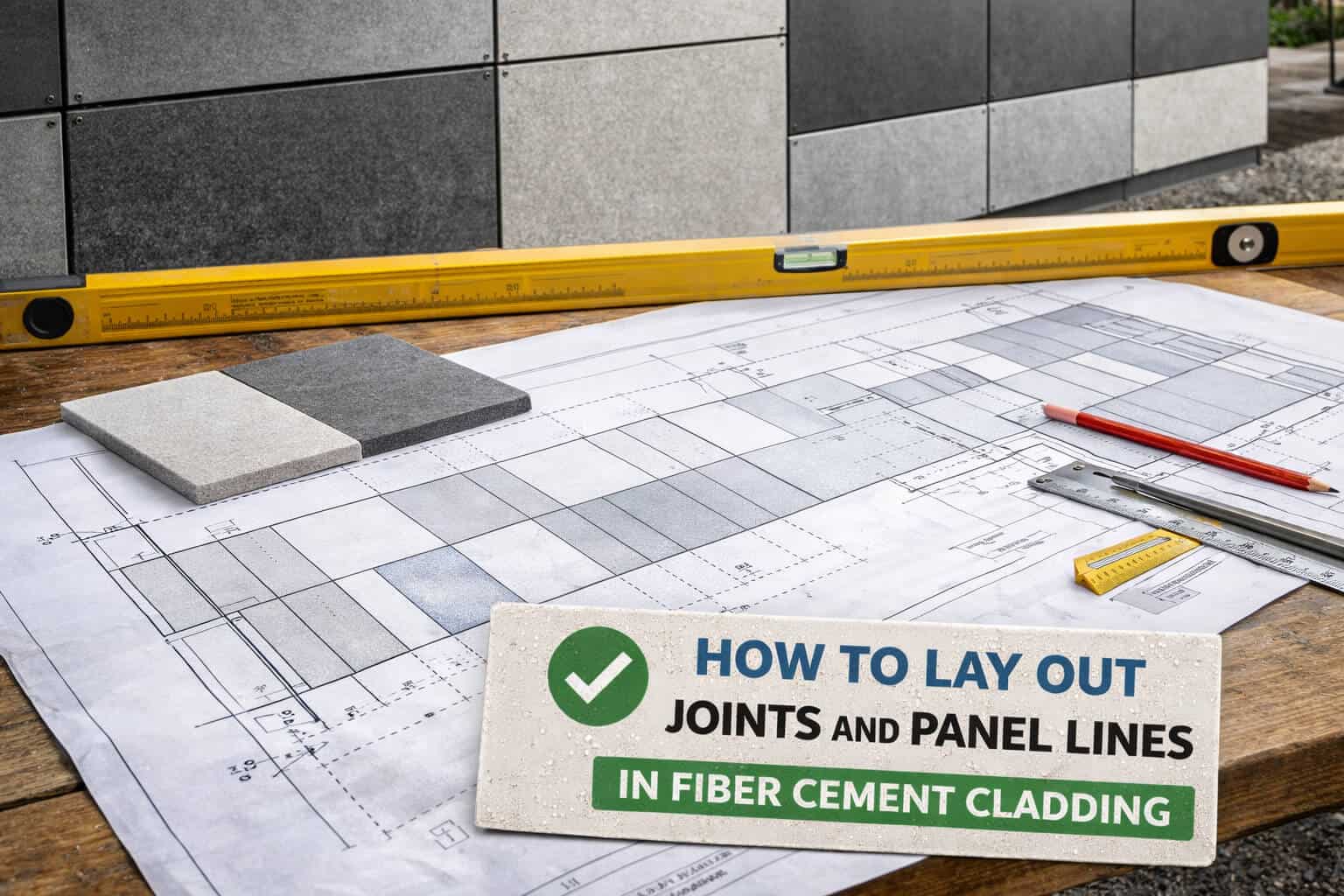
Laying out joints and panel lines in fiber cement cladding is not just a design exercise. It affects appearance, installation speed, material waste, and long-term performance. A clean layout can make a façade look deliberate and premium. A weak layout can make even a good material look awkward or inconsistent.
The good news is that most layout problems can be avoided. You need a clear panel strategy, consistent joint planning, and a good understanding of how the system works. Current manufacturer guidance for fiber cement cladding repeatedly emphasizes panel module planning, open-joint rainscreen design, control and expansion joints, and alignment with the support system.
Why joint layout matters so much
On a fiber cement façade, the joint layout is one of the first things people notice. Even non-technical viewers notice when panel lines feel balanced, disciplined, and intentional.
But this is not only about looks.
Good joint layout also helps with coordination. It makes the façade easier to install. It reduces awkward cuts. It supports the fixing system. It also helps keep the cladding aligned with openings, floor lines, and façade geometry.
Manufacturer design guides for fiber cement panels treat panel layout as a core design issue, not a last-minute drafting task. EQUITONE’s design guide specifically includes panel layout and module sizing guidance, while Nichiha’s design and installation documents tie joint strategy to movement and expansion rules.
Start with the façade grid
The best way to begin is with a façade grid.
Do not start by placing random panel sizes on the elevation. Start by understanding the main horizontal and vertical reference lines of the building. These usually include:
- floor levels
- window heads and sills
- parapet lines
- corners
- major façade breaks
- shadow gaps or expressed joints
Once those lines are clear, panel lines can be planned more intelligently. This helps the cladding look integrated with the architecture instead of sitting on top of it.
Think in modules, not isolated panels
One of the biggest layout mistakes is to treat each panel as a separate decision.
That usually leads to inconsistency.
A better approach is to think in modules. Create a repeatable rhythm. Decide whether the façade will use a regular grid, a staggered arrangement, or a more controlled random look. Even when the final appearance feels dynamic, the layout should still follow a clear rule.
EQUITONE’s design guidance highlights economic module sizes and explains that panel planning should consider standard sheet efficiency as well as façade design freedom. That is important because a beautiful layout should also be practical to fabricate and install.
Keep the joint width consistent
If there is one simple rule that improves most fiber cement façades, it is this:
Keep the joint width consistent.
Irregular joints make the façade look weak. They also make the system feel less controlled. Even a small inconsistency becomes visible across a large elevation.
Open-joint fiber cement systems are especially sensitive to this. EQUITONE’s open-joint cladding guidance presents the open-joint ventilated rainscreen as a deliberate design approach, which means the joint itself becomes part of the visual language of the façade.
That means the joints should not feel accidental. They should look planned.
Align panel lines with key building elements
Panel lines should work with the building, not against it.
Try to align joints and panel breaks with:
- window lines
- door frames
- slab edges
- façade recesses
- material transitions
- corner conditions
This creates a calmer and more professional result. It also helps the viewer read the façade more easily.
When panel lines ignore major architectural elements, the cladding can look disconnected. The material may still be good, but the façade will feel less resolved.
Avoid small leftover strips
One of the most common layout mistakes is ending up with narrow leftover pieces at one edge of the elevation or around openings.
These pieces often look weak. They can also create unnecessary fabrication complexity.
A better strategy is to test the panel pattern early and adjust the module before the design is fixed. Sometimes a small shift in joint spacing or panel width can eliminate an awkward strip across the whole façade.
This is one reason early layout planning matters. It is much easier to fix proportion problems in the design stage than on site.
Understand whether the façade is open-joint or sealed-joint
Before finalizing the layout, make sure the joint strategy matches the actual system.
Some fiber cement façades are designed as open-joint ventilated rainscreens. Others use trims, gaskets, or sealed conditions depending on the product and system. EQUITONE states that its fiber cement materials are developed for an open-joint ventilated rainscreen system, where the cavity behind the panels supports passive removal of water and vapor.
That matters because open-joint systems make the joint pattern more visible. The spacing, rhythm, and alignment become part of the design itself.
So before laying out panel lines, confirm the system type. A layout that works visually in one system may not feel right in another.
Plan for movement and expansion
This is a critical point.
Fiber cement cladding systems need movement planning. That includes control joints, expansion joints, and layout decisions that respect the manufacturer’s rules.
Nichiha’s AWP design guide states that panels may not be butted together, that vertical joints may not be split or staggered, and that control or expansion joints are 10 mm (3/8 inch) wide. Its horizontal installation guide also states that walls longer than 30 feet require a vertical expansion joint, and that control or expansion joints are required near outside corners and then approximately every 30 feet thereafter.
That means joint layout is not only visual. It is also technical.
If the façade is large, or if corners and long wall runs are involved, the panel line strategy must work with the movement requirements of the system.
Make the support grid work with the panel grid
A good-looking joint layout is not enough if the support system does not match it.
Panel lines should be coordinated with the framing or support rails behind the cladding. If the visible grid and the support grid are not coordinated, the installation becomes harder and the risk of awkward fixing conditions increases.
This is why layout planning should involve both design and buildability. The façade should not only look clean on paper. It should also make sense for the installer.
Current planning and application guidance for fiber cement façade systems repeatedly connects panel layout to framing logic, fixing methods, and full rainscreen system coordination.
Use corners carefully
Corners can make or break the façade.
A weak corner condition often disrupts the whole layout. That is why corner strategy should be decided early. Do not leave corners to the end of the design process.
Ask these questions early:
- Will the panel lines wrap around the corner?
- Will the corner be expressed?
- Will there be a trim or a shadow gap?
- Does the system require a nearby control joint?
Nichiha’s horizontal guide specifically calls for vertical control or expansion joints within a defined range from outside corners on long walls, which shows that corner layout is not just visual — it is also part of system performance.
Keep vertical and horizontal logic disciplined
A façade layout does not need to be perfectly symmetrical. But it should feel disciplined.
If the design uses a strong vertical rhythm, keep it strong. If the design uses a horizontal emphasis, support that clearly. Do not mix too many panel rules unless there is a very good architectural reason.
This is especially important on large elevations. Repetition is not a weakness in cladding. It is often what creates elegance.
Mock up the elevation before final approval
Before finalizing the façade, test the layout visually.
This can be done with elevation studies, simple digital mockups, or sample board arrangements. The goal is to check whether:
- the panel sizes feel balanced
- the joint rhythm feels intentional
- the openings align well
- the corners work
- the leftover pieces are acceptable
- the façade feels calm rather than busy
A panel layout can look logical on a drawing and still feel wrong when viewed as a whole. A mockup helps catch that early.
Common mistakes to avoid
The most common mistakes are:
- inconsistent joint widths
- random panel dimensions
- narrow leftover strips
- poor alignment with windows and doors
- ignoring control and expansion joint rules
- designing without the support grid in mind
- leaving corner decisions too late
- mixing too many layout rules on one elevation
Most of these problems are avoidable if the layout starts with a system, not with guesswork.
A simple layout checklist
Before finalizing your fiber cement cladding layout, check these points:
- Does the façade follow a clear grid or module?
- Are joint widths consistent?
- Do panel lines align with key architectural elements?
- Have small leftover strips been avoided?
- Is the layout compatible with the actual cladding system?
- Have movement and expansion requirements been respected?
- Does the support grid work with the visible panel lines?
- Have corner conditions been resolved clearly?
If the answer is yes to all of these, the façade is already in a much stronger position.
The practical takeaway
If you want to lay out joints and panel lines in fiber cement cladding well, do not treat it as a cosmetic step.
Treat it as part of the architecture and part of the system.
Start with the façade grid. Use repeatable modules. Keep the joint width consistent. Align panel lines with openings and major building elements. Avoid narrow leftover pieces. And always respect the movement rules of the cladding system.
That is how a fiber cement façade starts to look clean, intentional, and professionally resolved.
👉 Visit the Smartfiber Fiber Cement Board page to explore specs, sizes, and delivery options.
Authored by Smartcon Int’l. Trade & Marketing Ltd. on 18.04.2026. All rights reserved.
Façade specification
Need the right board for your façade system?
Share the façade build-up, exposure conditions, finish and documentation requirements. We can help assess the appropriate board and coordinate supply.