
Blog
How Fiber Cement Boards Improve Build Quality in Modular Construction
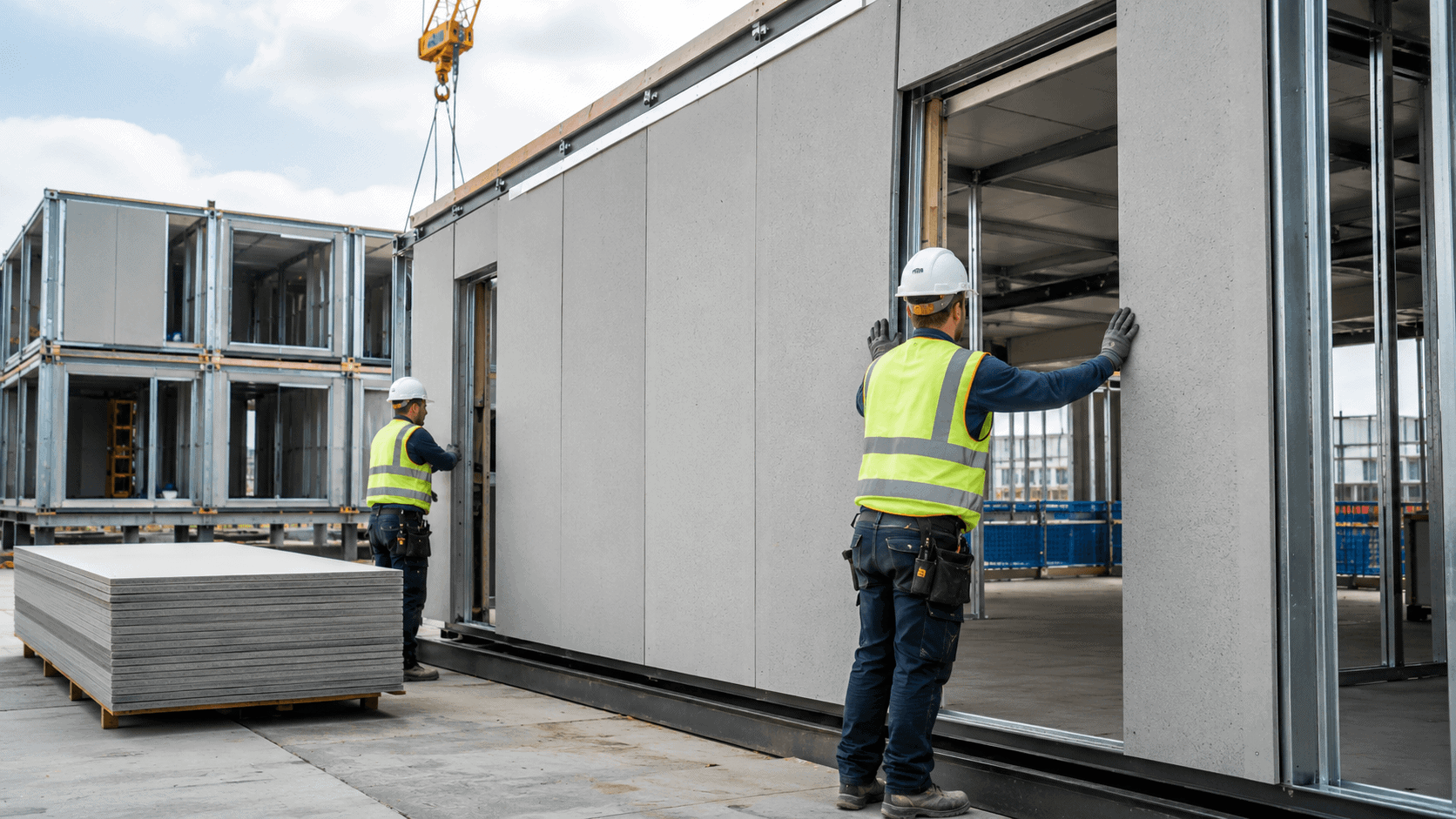
Modular construction depends on control, speed, and consistency. Instead of building everything from the ground up on site, many parts of the building are produced in a factory or controlled production environment.
This approach can reduce delays, improve quality control, and make construction more predictable.
However, the success of modular construction depends heavily on the materials used inside the wall, floor, roof, and façade systems. Boards must be durable, easy to handle, suitable for repeated production, and reliable during transport and installation.
This is where fiber cement boards can add real value.
Fiber cement boards in modular construction can help improve build quality by supporting cleaner wall systems, better durability, fire resistance, moisture resistance, and repeatable factory production.
Why Board Selection Matters in Modular Construction
In modular construction, a board is not just a surface layer.
It may be part of a wall lining, external sheathing system, façade backing layer, tile backing area, or fire-resistant assembly. It may also need to perform during factory handling, road transport, lifting, storage, and final site installation.
For this reason, board selection affects more than appearance.
It can influence:
- Production speed
- Panel consistency
- Durability
- Fire performance
- Moisture resistance
- Site installation quality
- Transport damage risk
- Finishing quality
- Long-term maintenance
A suitable board helps the modular manufacturer create a more reliable and repeatable building system.
Better Consistency in Factory Production
One of the main advantages of modular construction is repeatability.
Factory teams often produce similar wall panels, room modules, bathroom pods, or building units again and again. This makes consistency extremely important.
Fiber cement boards can support this process because they are manufactured in sheet form and can be cut, fixed, and finished in a controlled way.
This helps modular manufacturers:
- Standardize wall build-ups
- Repeat fixing patterns
- Prepare panels more efficiently
- Control board dimensions
- Reduce variation between units
- Improve inspection routines
When materials behave consistently, production teams can work more confidently.
Cleaner Wall and Panel Build-Ups
Modular construction requires clean and well-organized wall systems.
The board layer should work properly with the frame, insulation, membrane, fixing method, and final finish. If the board is difficult to handle or inconsistent, the whole build-up becomes harder to control.
Fiber cement boards can be used in many modular wall applications, including:
- Internal wall linings
- External sheathing layers
- Façade backing systems
- Tile backing areas
- Service zones
- High-traffic walls
- Utility spaces
- Wet-area backgrounds
This flexibility helps manufacturers simplify material planning and reduce unnecessary complexity.
Improved Durability During Handling and Transport
Modular units are not only built. They are also moved.
Panels and modules may be lifted, loaded, transported by road, unloaded, stored, and craned into position. Materials must cope with these stages without unnecessary damage.
Fiber cement boards offer good strength and durability when handled correctly. This makes them useful for modular systems where panels may face more movement before final installation than traditional on-site construction.
Good board durability can help reduce:
- Surface damage
- Edge damage
- Handling waste
- Transport-related repairs
- Site replacement costs
- Delays before installation
For modular manufacturers, fewer repairs mean better production flow and cleaner handover.
Stronger Moisture Resistance for Controlled Build Quality
Moisture control is important in modular construction.
Even when production takes place in a factory, modules may still face moisture during storage, transport, or site installation. Boards used in external walls, wet areas, bathrooms, kitchens, or service spaces need to be suitable for demanding conditions.
Fiber cement boards are valued because they provide better moisture resistance than many timber-based board options.
This can help improve build quality in areas such as:
- Bathroom pods
- Wet rooms
- Kitchens
- Utility rooms
- External wall systems
- Rainscreen façades
- Temporary exposure situations
- High-humidity environments
Correct detailing, storage, and installation are still important. However, moisture-resistant board selection gives the manufacturer a stronger starting point.
Fire Performance for Safer Modular Systems
Fire performance is a major consideration in modern construction.
In modular buildings, material choices must support the required fire strategy of the project. Wall linings, sheathing boards, façade layers, and service areas may all need to meet specific fire performance expectations.
Fiber cement boards are commonly selected because they offer strong fire-related properties compared with many combustible board materials.
This can support:
- Fire-resistant wall assemblies
- Safer internal linings
- External sheathing systems
- Service and utility areas
- Stair cores and corridors
- Public or commercial modular buildings
The final fire performance always depends on the complete system, not only one board. However, choosing suitable non-combustible or fire-resistant boards can support safer modular design.
Better Surface for Finishing
A modular building may leave the factory partly finished or almost complete.
This means the board surface needs to support consistent finishing quality. Fiber cement boards can provide a stable surface for several finishing approaches when prepared correctly.
Depending on the application, they may support:
- Painting
- Rendering
- Tiling
- Cladding systems
- Joint treatment
- Decorative finishes
A clean and consistent board surface helps factory teams maintain finishing standards across multiple modules.
This is especially useful for projects with repeated room types, such as hotels, student accommodation, housing units, healthcare buildings, and worker accommodation.
Useful for Wet Areas and Bathroom Pods
Bathroom pods are one of the clearest examples of modular construction.
They require moisture-resistant, stable, and reliable backing materials. The board must work with waterproofing systems, tile adhesives, membranes, and mechanical fixings.
Fiber cement boards are useful in wet-area applications because they provide a durable backing layer when used with the correct complete system.
They can help support:
- Bathroom walls
- Shower areas
- Tile backing
- Utility rooms
- Washrooms
- Commercial wet spaces
This makes them attractive for modular manufacturers producing repeated wet-area units.
Suitable for External Sheathing and Façade Backing
Many modular buildings need external sheathing or façade backing boards.
These boards must support the external wall build-up and work with membranes, battens, cladding rails, insulation, and façade finishes.
Fiber cement boards can be suitable for external sheathing and rainscreen backing applications when specified correctly.
They can support modular projects by providing:
- A durable external board layer
- Better moisture resistance
- Compatibility with façade systems
- A stable backing for further layers
- Improved confidence during site assembly
This is especially useful when modules are transported to site and completed with external cladding after installation.
Faster and More Predictable Installation
Speed is one of the main reasons companies choose modular construction.
Materials that are easy to cut, fix, inspect, and finish help protect this advantage. If a board creates too many site adjustments, the benefit of factory production may be reduced.
Fiber cement boards can support faster and more predictable installation when the production team standardizes:
- Board dimensions
- Cutting plans
- Fixing patterns
- Screw positions
- Joint layouts
- Edge details
- Inspection steps
Standardization improves productivity and reduces errors.
Reduced Maintenance and Longer Service Life
Modular buildings are often used in demanding environments.
They may serve as schools, healthcare facilities, hotels, offices, housing units, site accommodation, or commercial spaces. In many of these projects, durability and maintenance matter as much as speed.
Fiber cement boards can help support lower maintenance expectations because they offer good durability, moisture resistance, and impact resistance when used correctly.
This can be especially valuable in:
- Corridors
- Utility spaces
- Public buildings
- Wet areas
- External walls
- Service areas
- High-use modular buildings
A more durable board system can reduce repair needs and improve long-term value.
Better Quality Control Before Site Delivery
Factory production allows inspections before modules leave the production line.
This is a major advantage of modular construction. Fiber cement boards can support this process because board fixing, surface preparation, joint quality, and finishing can be checked in a controlled setting.
Quality control teams can inspect:
- Board alignment
- Screw fixing
- Surface cleanliness
- Joint treatment
- Edge condition
- Moisture exposure
- Finishing readiness
- Panel consistency
This reduces the risk of discovering problems only after the modules arrive on site.
Practical Specification Tips
To get the best performance from fiber cement boards in modular construction, specification should be clear.
Important points include:
- Select the correct board thickness
- Match the board to the application
- Confirm fire performance requirements
- Check moisture exposure conditions
- Use suitable screws and fixings
- Follow correct support spacing
- Plan joint treatment carefully
- Protect boards during storage and transport
- Inspect boards before finishing
- Coordinate with the full wall or façade system
The board should not be specified in isolation. It should be part of a complete and well-planned modular build-up.
Where Fiber Cement Boards Add the Most Value
Fiber cement boards are especially useful in modular construction when durability, moisture resistance, fire performance, and finish quality matter.
They can add value in:
- Bathroom pods
- Kitchen modules
- External wall panels
- Rainscreen façade systems
- Corridor walls
- Utility areas
- Commercial modular units
- Healthcare buildings
- Student accommodation
- Hotel modules
- Temporary and permanent modular buildings
In these applications, a stronger board layer can help improve both production quality and final building performance.
Final Thoughts
Modular construction depends on reliable materials and repeatable processes.
Fiber cement boards can support modular manufacturers by improving durability, fire performance, moisture resistance, finishing quality, and production consistency. They also help create cleaner wall systems and more predictable factory workflows.
The key is to use them correctly.
When fiber cement boards are specified as part of a complete system and handled with proper site and factory procedures, they can help modular buildings achieve better quality, stronger performance, and a more professional final result.
Need pricing, technical documents, or loading guidance for fiber cement boards? Contact Smartcon with your required thickness, dimensions, quantity, and delivery destination. Our team will help you review the suitable options and provide practical export support from Turkey.
👉 Visit the Smartfiber Fiber Cement Board page to explore specs, sizes, and delivery options.
Authored by Smartcon Int’l. Trade & Marketing Ltd. on 02.06.2026. All rights reserved.
Façade specification
Need the right board for your façade system?
Share the façade build-up, exposure conditions, finish and documentation requirements. We can help assess the appropriate board and coordinate supply.