
Blog
Fiber Cement Board on Steel Frame vs Timber Frame: Installation Differences
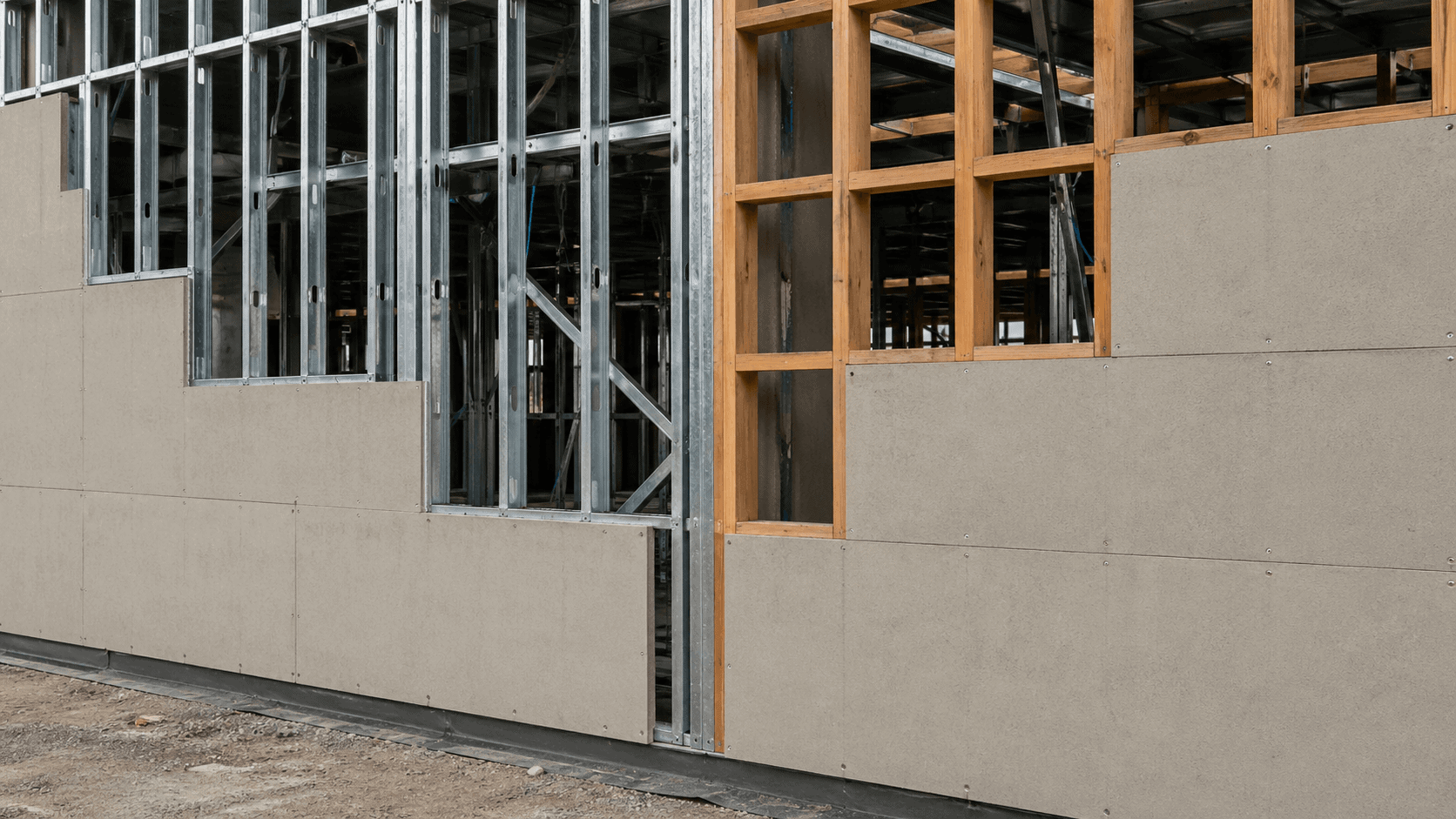
Fiber cement board can be installed on both steel frame and timber frame systems. Both options can work well when the board is fixed correctly. However, the installation details are not exactly the same.
Steel and timber behave differently. They respond differently to moisture, temperature, movement, screw fixing, and site conditions. This means the installer should not treat both subframes in the same way.
For architects, contractors, developers, and specifiers, the key point is simple: fiber cement board performance depends not only on the board itself, but also on the support frame behind it.
This guide explains the main installation differences between steel frame and timber frame systems.
Why the Support Frame Matters
The support frame is the structure that carries the fiber cement board.
It may be made from:
- Light gauge steel studs
- Galvanized steel profiles
- Steel façade rails
- Timber studs
- Timber battens
- Timber frame wall systems
The frame affects how the board is fixed, supported, aligned, and protected.
If the frame is uneven, unstable, or unsuitable, even a good fiber cement board may not perform correctly.
The frame influences:
- Board flatness
- Fixing strength
- Screw type
- Screw spacing
- Edge support
- Moisture behavior
- Movement control
- Long-term durability
- Final finish quality
That is why the frame must be considered before board installation starts.
Steel Frame and Timber Frame: The Basic Difference
Steel frame systems are usually more dimensionally stable than timber. Steel does not absorb water in the same way as timber. It also does not shrink, swell, or warp like wood.
Timber frame systems can also be reliable, but timber is a natural material. It may move with moisture and temperature changes. It can swell, shrink, twist, or warp if it is not properly selected, treated, dried, and protected.
This difference affects fiber cement board installation.
With steel, the main concerns are corrosion protection, screw compatibility, frame alignment, and thermal movement.
With timber, the main concerns are moisture content, timber movement, fixing grip, treatment, ventilation, and long-term stability.
Installing Fiber Cement Board on Steel Frame
Steel frame systems are common in dry construction, external sheathing, modular buildings, and façade applications.
Fiber cement boards are often installed on light gauge steel studs, galvanized profiles, or steel support rails.
Main advantages of steel frame
Steel frames offer several practical advantages:
- Good dimensional stability
- Straight profiles when installed correctly
- Suitable for modern dry construction
- Compatible with modular and offsite systems
- Less risk of swelling or warping
- Consistent fixing lines
- Useful for external sheathing and façade systems
A well-installed steel frame can provide a stable and accurate base for fiber cement boards.
Key checks before fixing to steel
Before fixing fiber cement boards to steel, check:
- Steel profile thickness
- Profile spacing
- Galvanization or corrosion protection
- Frame alignment
- Stud position
- Edge support
- Screw type
- Screw length
- Fixing centres
- Building movement requirements
The board should not be fixed to an unstable, misaligned, or unsupported frame.
Screw Selection for Steel Frame
When installing fiber cement board on steel, the screw must be suitable for both the board and the steel profile.
Common requirements may include:
- Corrosion-resistant screws
- Self-drilling screws where suitable
- Correct drill point for steel thickness
- Correct head type
- Correct screw length
- Proper holding strength
The screw must penetrate and hold the steel frame properly.
If the screw is too short, too weak, or not suitable for the steel thickness, fixing performance may be poor.
Overdriving screws should also be avoided. The screw head should hold the board firmly without damaging the board surface.
Steel Frame Alignment Is Critical
Steel profiles are usually straight, but they still need correct installation.
If the frame is not aligned, the fiber cement board may sit unevenly. This can cause visible waves, stress at fixings, poor joint alignment, or problems with the final finish.
Before fixing boards, check:
- Vertical alignment
- Horizontal alignment
- Stud spacing
- Rail position
- Level and plumb
- Support behind board edges
- Support around openings
- Support around service penetrations
A board should not be forced into position over a twisted or uneven frame.
Movement in Steel Frame Systems
Steel can expand and contract with temperature changes.
This movement is usually predictable, but it must still be considered in external wall and façade systems.
Movement may be affected by:
- Building height
- Temperature variation
- Sun exposure
- Frame design
- Board size
- Fixing method
- Joint spacing
- Movement joints
Correct joint gaps and movement detailing help reduce stress in the board system.
For large elevations, always check whether movement joints are required.
Corrosion Protection for Steel Frame
Steel used behind fiber cement board should be properly protected against corrosion.
This is especially important in:
- External walls
- Coastal areas
- High-humidity environments
- Wet construction zones
- Poorly ventilated cavities
- Areas exposed to leaks or condensation
Galvanized or otherwise protected steel profiles are usually preferred.
Screws and accessories should also be corrosion-resistant. Using the wrong fixing can create long-term problems even if the board itself performs well.
Installing Fiber Cement Board on Timber Frame
Timber frame systems are also widely used in construction.
Fiber cement boards may be fixed to timber studs, timber battens, timber frames, or timber substructures.
Timber can provide good fixing grip. However, it must be dry, straight, treated, and properly protected.
Main advantages of timber frame
Timber frame systems can offer:
- Strong screw holding
- Easy cutting and fixing on site
- Good workability
- Common use in residential construction
- Practical installation with simple tools
- Compatibility with many dry construction methods
Timber can be a practical support for fiber cement boards when the frame is correctly prepared.
Key checks before fixing to timber
Before fixing boards to timber, check:
- Timber moisture content
- Timber straightness
- Timber treatment
- Batten size
- Stud spacing
- Frame stability
- Ventilation
- Edge support
- Screw type
- Fixing depth
- Protection from rain and trapped moisture
Timber should not be wet, twisted, split, or unstable before board installation.
Moisture Is the Main Timber Frame Risk
The biggest difference between steel and timber is moisture behavior.
Timber can absorb moisture. If timber gets wet, it may swell, shrink, twist, or decay over time.
This movement can affect the fiber cement board fixed to it.
Common risks include:
- Board movement
- Cracks at joints
- Uneven surface
- Loose fixings
- Poor finish quality
- Timber rot
- Mould risk
- Reduced long-term stability
For this reason, timber used behind fiber cement boards should be protected from long-term moisture exposure.
Timber Must Be Straight and Stable
Fiber cement boards need a flat support surface.
If timber battens or studs are twisted, bowed, or uneven, the board may follow that unevenness.
This can create:
- Wavy wall surfaces
- Poor joint alignment
- Stress around screws
- Visible defects after finishing
- Uneven cladding support
Before installation, timber should be checked carefully. Defective battens or studs should be replaced.
Trying to correct poor timber alignment by forcing the board into place is not good practice.
Screw Selection for Timber Frame
Screws used for timber frame installation must provide enough grip in the timber.
Important points include:
- Correct screw type
- Corrosion resistance
- Correct screw length
- Sufficient embedment into timber
- Suitable head type
- No splitting of timber
- Correct edge distance
- No overdriving
The screw should hold the board securely without crushing the board surface.
If the timber is too close to the edge, too narrow, or already split, fixing strength may be reduced.
Ventilation Behind Timber Systems
Ventilation is especially important in timber-backed external wall systems.
A ventilated cavity can help reduce trapped moisture and improve drying.
This is important because timber should not remain wet behind the board system.
Depending on the wall build-up, the system may need:
- Ventilated cavity
- Breather membrane
- Drainage path
- Correct batten layout
- Insect mesh
- Base ventilation
- Top ventilation
- Moisture-resistant detailing
Good ventilation helps protect both the timber frame and the board system.
Board Joint Differences on Steel and Timber
Board joints must be planned carefully on both steel and timber frames.
However, the support behind the joint may differ.
On steel frame systems, joints usually align with steel studs or rails. The fixing line should be secure and stable.
On timber systems, joints may align with timber battens or studs. The timber behind the joint must be wide and stable enough to hold fixings properly.
For both systems, check:
- Correct joint gap
- Full support behind board edges
- Correct screw spacing
- No unsupported edges
- No forced board contact
- Suitable joint treatment
- Movement allowance
Board joints should never be treated as random gaps between panels.
External Sheathing: Steel Frame vs Timber Frame
For external sheathing applications, both steel and timber can be used.
Steel frame systems are often preferred in modular, commercial, and light gauge steel construction because they provide consistent profiles and dimensional stability.
Timber frame systems are common in residential and low-rise construction, especially where timber is already the main wall structure.
The choice depends on:
- Building type
- Project location
- Fire requirements
- Moisture exposure
- Structural design
- Local construction practice
- Cost
- Availability
- Installer experience
For external sheathing, moisture control and correct detailing are essential in both systems.
Fire Performance Considerations
Fiber cement board is often selected for fire-safe construction.
However, the fire performance of the full wall system depends on more than the board.
The frame, insulation, membranes, cavity, fixings, sealants, and finishes must also be considered.
Steel and timber frames behave differently in fire conditions.
Specifiers should check:
- Full system fire classification
- Frame material
- Board thickness
- Cavity barriers
- Fire stopping
- Penetration details
- Joint treatment
- Local regulations
Do not assume that using fiber cement board alone automatically gives the full wall build-up the required fire performance.
Which Frame Is Better for Fiber Cement Board?
There is no single answer.
Steel frame may be better when dimensional stability, commercial dry construction, modular systems, or non-combustible support structures are important.
Timber frame may be better where timber construction is already the main building method and where simple fixing and workability are priorities.
The better choice depends on the project.
The key question is not only “steel or timber?” The better question is:
Is the frame flat, stable, compatible, protected, and suitable for the board system?
If the answer is yes, fiber cement board can perform well on either frame.
Common Mistakes to Avoid
Avoid these common mistakes when installing fiber cement board on steel or timber frame:
- Using the same screw type for steel and timber
- Fixing boards to misaligned frames
- Ignoring timber moisture content
- Using untreated or unstable timber externally
- Using unprotected steel in humid areas
- Overdriving screws
- Leaving board edges unsupported
- Forgetting movement joints
- Ignoring ventilation in timber-backed systems
- Installing boards over wet or warped battens
- Placing joints away from proper support
- Assuming the board alone solves all fire or moisture requirements
Most installation problems begin with poor frame preparation.
Site Checklist Before Installation
Before installing fiber cement boards, check the following:
- Is the frame type suitable for the project?
- Is the frame straight, level, and stable?
- Are studs or battens correctly spaced?
- Are board edges fully supported?
- Are the correct screws selected for steel or timber?
- Is corrosion protection considered?
- Is timber dry, treated, and stable?
- Is ventilation needed behind the system?
- Are movement gaps planned?
- Are joints aligned with supports?
- Are openings and penetrations supported?
- Are fire and moisture requirements checked?
This checklist helps avoid costly installation errors.
Final Thoughts
Fiber cement board can be installed successfully on both steel frame and timber frame systems.
The main difference is how the support material behaves.
Steel offers good dimensional stability but needs correct screw selection, alignment, and corrosion protection.
Timber offers strong fixing grip and easy workability, but it must be dry, straight, protected, and properly ventilated.
In both cases, the frame must be flat, stable, correctly spaced, and compatible with the board system.
When the right frame, fixings, joints, and moisture details are used, fiber cement boards can provide a reliable solution for modern wall, façade, and external sheathing applications.
Frame choice is important, but the board material should also be selected carefully. For a broader comparison of cement-based boards, including fire rating, moisture behavior, exterior suitability, and typical applications, see our fiber cement board vs cement particle board comparison.
👉 Visit the Smartfiber Fiber Cement Board page to explore specs, sizes, and delivery options.
Authored by Smartcon Int’l. Trade & Marketing Ltd. on 30.04.2026. All rights reserved.
Façade specification
Need the right board for your façade system?
Share the façade build-up, exposure conditions, finish and documentation requirements. We can help assess the appropriate board and coordinate supply.