
Blog
How to Install Fiber Cement Boards on Metal Stud Framing
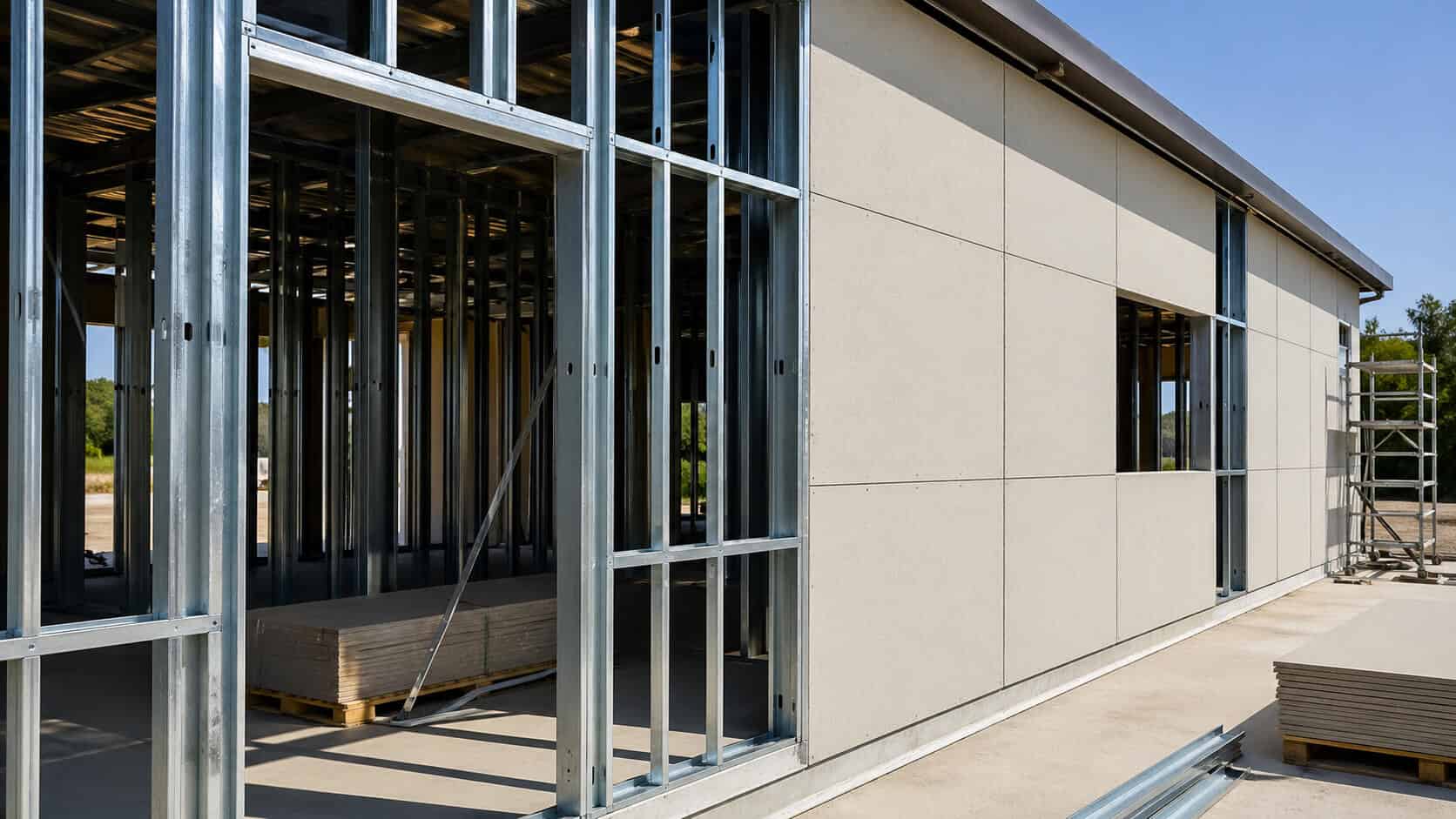
Metal stud framing is widely used in modern construction. It is common in partition walls, dry construction systems, modular buildings, façade backing, and external sheathing applications.
Fiber cement boards can be installed on metal studs when the framing is properly prepared and the correct fixing method is used.
A good installation depends on simple but important details. The studs must be straight. The board edges must be supported. The fixings must be suitable for metal framing. Gaps, joints, and openings must be planned before the boards are fixed.
This guide explains how to install fiber cement board on metal studs in a practical and site-friendly way.
Why Use Fiber Cement Boards on Metal Studs?
Fiber cement boards and metal stud framing work well together in many wall systems.
Metal studs provide a lightweight and straight framing structure. Fiber cement boards provide a strong, stable, and durable board surface. Together, they can be used in many internal and external wall applications.
Common uses include:
- Internal dry construction walls
- External sheathing
- Façade backing boards
- Modular building walls
- Shaft walls
- Service walls
- Partition systems
- Wet-area wall build-ups
- Fire-conscious wall assemblies, depending on the full system
The final performance depends on the complete wall design, not only the board itself. The frame, board, fixings, joints, insulation, membranes, and finishing layers must work together.
Metal framing requires different screws, movement planning, and corrosion protection from timber framing. Review the main steel frame and timber frame installation differences before finalizing the support system.
Check the Metal Stud Frame First
Before installing fiber cement boards, inspect the metal stud frame.
The frame should be straight, stable, properly fixed, and suitable for the board application. If the metal studs are twisted, loose, or poorly aligned, the boards may not sit flat.
Do not use the board to correct a bad frame.
Check that:
- The studs are straight and level
- Tracks are properly fixed
- Stud spacing follows the project specification
- The frame is strong enough for the selected board
- Openings are properly framed
- Corners are correctly supported
- Extra backing is added where heavy fixtures may be installed
- The frame is clean and free from loose metal pieces
A clean and stable frame makes the installation easier and reduces future problems.
Choose the Right Board Thickness
The correct board thickness depends on the wall application.
A board used for internal lining may not require the same thickness as a board used for external sheathing, façade backing, or impact-prone areas. The required thickness may also depend on stud spacing, board size, building use, and the finishing system.
Before installation, check the product datasheet and project specification.
Confirm:
- The approved board thickness
- The board size
- The wall application
- The fixing method
- The required support spacing
- The finishing or coating system
- Any fire, moisture, acoustic, or impact requirements
Using the correct board from the beginning prevents costly replacement later.
Use Suitable Screws for Metal Framing
The screws must be compatible with metal studs.
For metal framing, installers usually need screws designed to fix boards to steel or galvanized profiles. The screw type, length, coating, head type, and drilling capacity should match the board thickness and metal stud thickness.
In external or moisture-prone applications, corrosion resistance is especially important.
Check that the screws are:
- Suitable for fiber cement board
- Suitable for metal framing
- Long enough for secure fixing
- Corrosion-resistant where required
- Compatible with the board and wall system
- Installed according to manufacturer guidance
Avoid using random screws from site stock. The wrong screw can damage the board, fail to hold properly, or corrode over time.
Screw length, head design, drill point, coating, and holding capacity must suit both the board and the steel profile. Review how to choose the correct screws for metal stud framing before installation.
Plan Board Layout Before Fixing
Board layout should be planned before installation starts.
This is especially important on metal stud framing because board edges need support. If a vertical board edge falls between studs, it may not be properly fixed unless additional framing is added.
Plan the layout so that:
- Vertical board edges land on studs
- Horizontal joints are supported where required
- Narrow board strips are avoided where possible
- Joints around windows and doors are planned carefully
- Boards are installed in a stable and practical sequence
- Openings and penetrations are considered before cutting
A few minutes of planning can prevent many fixing problems.
Board direction affects joint positions, edge support, cutting waste, and fixing lines. Check how to choose a horizontal or vertical board layout before the first panel is cut.
Support Board Edges Properly
Fiber cement board edges should be supported according to the wall system design.
Unsupported edges can move, crack, or create weak points. This is especially important around corners, openings, service penetrations, and board joints.
On metal stud framing, edge support may be provided by:
- Vertical studs
- Horizontal noggins
- Additional metal profiles
- Tracks
- Framing around openings
- Backing plates where required
Do not leave board edges floating unless the approved system allows it.
If an edge has no support, add support before fixing the board.
Leave the Correct Gaps Between Boards
Fiber cement boards should not be forced tightly together unless the system specifically allows it.
Controlled gaps help accommodate movement, joint treatment, sealant, coating, and finishing tolerances. The correct gap depends on the board, application, and manufacturer guidance.
Check the required gap:
- Between boards
- At corners
- Around window and door frames
- Around service penetrations
- At the base of the wall
- At the top of the wall
- Where boards meet different materials
Consistent gaps create a better finish and reduce stress in the board system.
Fix the Boards Without Overdriving Screws
Screw depth matters.
The screw head should hold the board firmly without crushing the surface. If screws are overdriven, they can weaken the fixing point and damage the board face. If screws are underdriven, the surface may not be flat for finishing.
When fixing to metal studs:
- Hold the board flat against the frame
- Start fixing from a stable position
- Keep the board aligned
- Drive screws straight
- Do not over-tighten
- Keep fixings away from fragile board edges
- Follow the recommended fixing pattern
The aim is a secure fixing, not a crushed board surface.
Fixing centres and board gaps should be considered together rather than as separate details. See our guide to fiber cement board screw spacing and joint gaps before marking the fixing grid.
Check Fixing Distance From Board Edges
Fixings placed too close to the edge can damage the board.
This is more likely around cut edges, corners, narrow strips, window openings, and door openings. Edge distance should follow the product and system guidance.
Before fixing, make sure there is enough board material around the screw. If a piece is too narrow to fix properly, consider changing the layout or adding support.
Good edge distance helps prevent:
- Corner breakage
- Edge cracking
- Loose fixings
- Surface damage
- Weak joints
This is one of the most important installation details.
Correct screw position protects board edges and distributes stress into the metal frame. Review the correct edge distance and fixing patterns before drilling or fixing near corners and cut edges.
Be Careful Around Openings
Windows, doors, access panels, and service openings need extra attention.
Window and door openings also require coordinated framing, flashing, joint positioning, and sealing. See how to detail fiber cement boards around windows and doors before closing these areas.
Pipes, cables, ducts, and mechanical openings must also be framed and sealed correctly. Follow the correct steps to support and seal fiber cement board service penetrations.
Metal framing around openings should be complete before boards are installed. The boards should be cut cleanly and fixed to proper support around the opening.
Check that:
- The opening is square
- The frame is reinforced where needed
- Board edges are supported
- Gaps around frames are consistent
- Cut edges are treated if required
- Fixings are not too close to corners
- Board joints are not placed in weak positions
Openings are common weak points if they are rushed.
Treat Cut Edges Where Required
Fiber cement boards are often cut on site.
Cut edges may appear at corners, openings, service penetrations, wall edges, and board ends. Depending on the board and application, cut edges may need sealing, priming, coating, or protection.
This is especially important in external, wet-area, or exposed applications.
Check the manufacturer’s instructions before leaving cut edges untreated.
Also remove cutting dust before finishing. Dust can affect adhesion, appearance, and coating performance.
Where the board specification requires edge treatment, use a compatible product to protect freshly cut fiber cement board edges before installation or finishing.
Consider Moisture and Membrane Details
If the fiber cement board is used in an external wall system, moisture protection must be considered.
The board may be part of a larger build-up that includes a weather barrier, breather membrane, insulation, cavity, cladding, flashing, and sealant details. The metal stud frame and board must be installed so these layers can work correctly.
Pay attention to:
- Membrane continuity
- Flashing around openings
- Sill details
- Drainage paths
- Ventilation gaps
- Sealing around penetrations
- Protection of exposed edges
- Corrosion-resistant components
A good wall system manages moisture instead of trapping it.
In external light-steel-frame walls, the board should not automatically be treated as the only weather barrier. Check when a breather membrane is needed behind fiber cement board as part of the full wall build-up.
Check Fire, Acoustic, and System Requirements
Metal stud walls are often designed to meet specific performance requirements.
These may include fire resistance, acoustic performance, moisture resistance, or impact resistance. Fiber cement boards can be part of such wall systems, but the complete build-up must match the approved specification.
Before closing the wall, check:
- Board type and thickness
- Number of board layers
- Stud spacing
- Insulation type
- Cavity barriers or fire stops
- Joint treatment
- Sealant requirements
- Approved fixing pattern
- Penetration details
Do not change the wall build-up casually. Small changes can affect system performance.
Where fire resistance is required, board thickness, layers, framing, insulation, fixings, joints, and penetrations must match the approved assembly. Review the key principles of fire-rated wall assemblies using fiber cement boards.
Inspect the Installation Before Finishing
Before applying paint, coating, cladding, tiles, or another layer, inspect the board installation.
Look for:
- Loose boards
- Missing fixings
- Overdriven screws
- Unsupported edges
- Uneven joints
- Damaged corners
- Dirty surfaces
- Incorrect gaps
- Untreated cut edges
- Blocked cavities or membranes
- Poorly detailed openings
Correct these issues before finishing starts. It is much easier to fix them while the wall is still open.
Common Mistakes to Avoid
Avoid these common mistakes when installing fiber cement boards on metal studs:
- Installing boards over twisted or loose studs
- Using the wrong screws
- Fixing board edges without support
- Overdriving screws into the board
- Placing screws too close to board edges
- Forcing boards tightly together
- Ignoring cut-edge treatment
- Using the wrong board thickness
- Forgetting moisture protection in external walls
- Leaving openings poorly supported
- Changing fire or acoustic build-ups without approval
- Closing the wall without inspection
Most of these mistakes are easy to prevent with good planning.
Simple Installation Checklist
Before finishing the wall, check the following:
- Is the metal stud frame straight and stable?
- Is the correct board thickness installed?
- Are the correct screws used?
- Are board edges properly supported?
- Are joints neat and consistent?
- Are gaps correct?
- Are screws flush and not overdriven?
- Are fixings kept away from fragile edges?
- Are windows and doors properly framed?
- Are cut edges treated where required?
- Are moisture details complete?
- Are fire and acoustic requirements followed?
- Is the surface clean and ready for finishing?
- Has the installation been inspected and photographed?
This checklist helps prevent avoidable problems before the wall is closed or covered.
For a wider review before the wall is closed, use our complete fiber cement board installation checklist to document framing, fixings, joints, openings, moisture protection, and final surface condition.
Final Thoughts
Installing fiber cement board on metal studs is a practical and reliable method for many modern wall systems.
The key is not complicated. Start with straight metal framing, choose the correct board thickness, use suitable screws, support all required edges, maintain proper gaps, and inspect the installation before finishing.
Fiber cement boards can perform strongly in dry construction, external sheathing, façade backing, and modular wall systems when installed correctly.
A good result depends on disciplined site work. Plan the layout, fix the boards carefully, protect cut edges where required, and make sure the whole wall build-up works as a complete system.
When fiber cement boards are used on metal stud framing, the material decision should be made before the installation details are finalized. If you are comparing cement-based board options, our fiber cement board vs cement particle board article gives a wider technical overview.
👉 Visit the Smartfiber Fiber Cement Board page to explore specs, sizes, and delivery options.
Authored by Smartcon Int’l. Trade & Marketing Ltd. on 25.04.2026. All rights reserved.
Façade specification
Need the right board for your façade system?
Share the façade build-up, exposure conditions, finish and documentation requirements. We can help assess the appropriate board and coordinate supply.