
Blog
Fire-Resistant Modular Buildings: How Fiber Cement Boards Meet Safety Codes
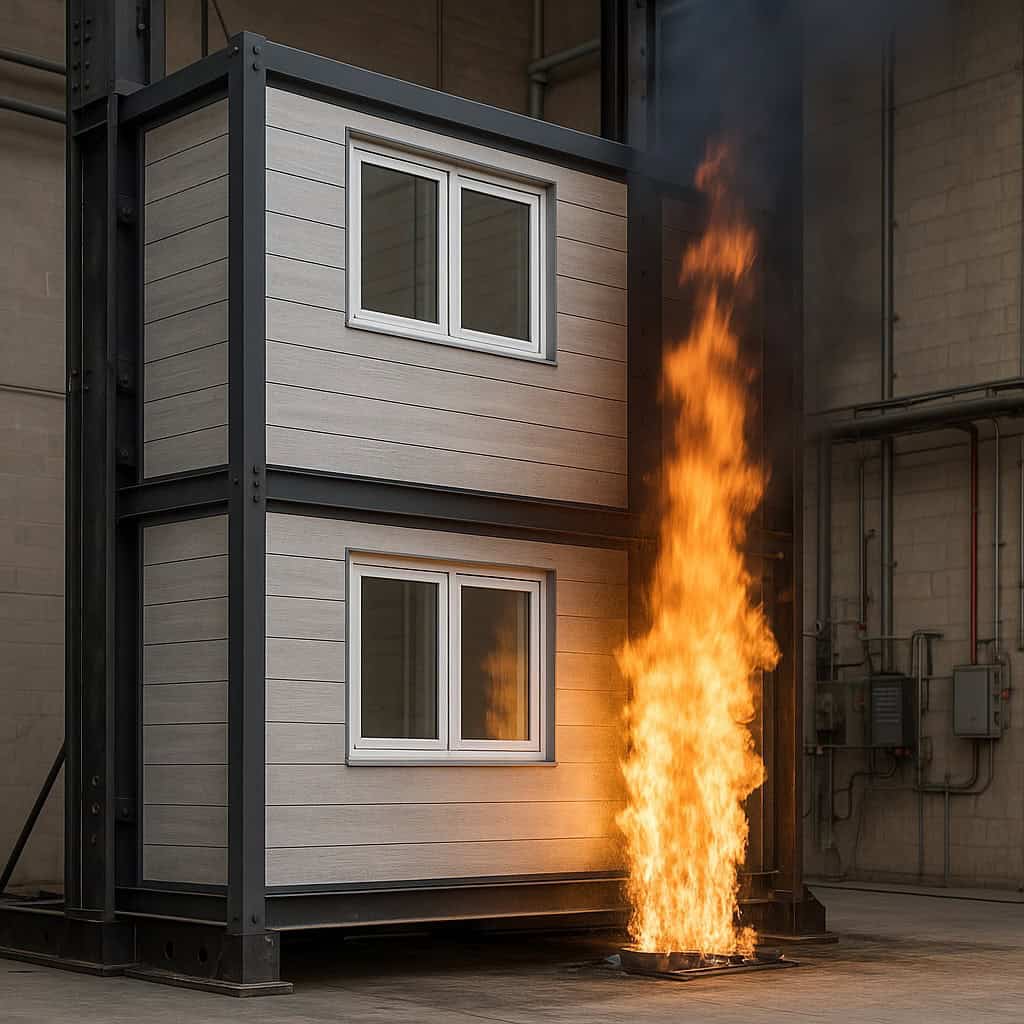
Introduction
Fire safety is one of the most critical challenges in modular construction. Unlike conventional concrete buildings, modular and prefabricated structures rely heavily on panelized wall systems, where incorrect material selection can significantly increase fire spread risk.
Fiber cement boards have become the preferred choice for fire-safe modular construction due to their non-combustible composition, thermal stability, and compliance with international fire safety standards.
Why Fiber Cement Boards Are Trusted for Fire Protection
Fiber cement boards are composed of Portland cement, silica, and cellulose fibers, resulting in a Class A1/A2 non-combustible material (depending on product and standard).
They do not ignite, drip, melt, or produce toxic smoke, making them ideal for use in:
- Modular schools and hospitals
- Fire-safe residential container homes
- Temporary military or disaster relief housing
- High-density worker accommodations
Compliance with International Fire Safety Standards
Fiber cement boards undergo rigorous testing to verify their suitability for modular buildings:
EN 13501-1 (European Standard)
- Typical rating: Class A1 or A2 (non-combustible or very limited combustibility)
- Determines reaction to fire, flame spread, and smoke production
ASTM E84 (American Standard — Steiner Tunnel Test)
- Measures Flame Spread Index (FSI) and Smoke Developed Index (SDI)
- Fiber cement commonly achieves Class A rating (FSI < 25, SDI < 450)
BS 476 (UK Standard)
- Common pass levels: Part 4 (Non-Combustibility) & Part 6 (Fire Propagation)
- Required for UK modular building approvals
ISO 1716 and ISO 1182 (Global Non-Combustibility Evaluation)
- Used for Passive House, energy-neutral modular structures
Real-World Fire Protection Performance
In fire exposure scenarios, fiber cement boards:
- Delay flame penetration, protecting core structure
- Prevent flashover, as they do not fuel the fire
- Maintain integrity under extreme temperature changes
- Do not emit molten drips or toxic gases
- Increase evacuation time — crucial in modular hotels, schools, etc.
When installed as part of a properly rated wall system with insulation, substructure, and sealing, they satisfy EI60, EI90, or higher fire resistance ratings depending on the building requirement.
Why Modular Developers Are Adopting Fiber Cement
- Compliant with global safety certification standards
- Compatible with steel-framed modular systems
- Suitable for exterior façades, interior partitions, corridors, stair cores
- Accepted across healthcare, education, residential, and defense sectors
- Supports insurance, regulatory approvals, and risk mitigation
Conclusion
Fiber cement boards are not just decorative façade materials — they are critical fire safety components in modular construction systems. Their non-combustible rating, proven compliance with EN 13501-1 and ASTM E84, and real-world fire resistance performance make them one of the safest material choices for zero-compromise modular and prefabricated buildings.
Correctly specified, they help modular builders meet global fire safety regulations while ensuring occupant protection and regulatory approval confidence.
👉 Visit the Smartfiber Fiber Cement Board page to explore specs, sizes, and delivery options.
Authored by Smartcon Int’l. Trade & Marketing Ltd. on 18.10.2025. All rights reserved.
Façade specification
Need the right board for your façade system?
Share the façade build-up, exposure conditions, finish and documentation requirements. We can help assess the appropriate board and coordinate supply.