
Blog
Fiber Cement Board Density Explained: Why It Matters for Handling, Fixing, and Performance
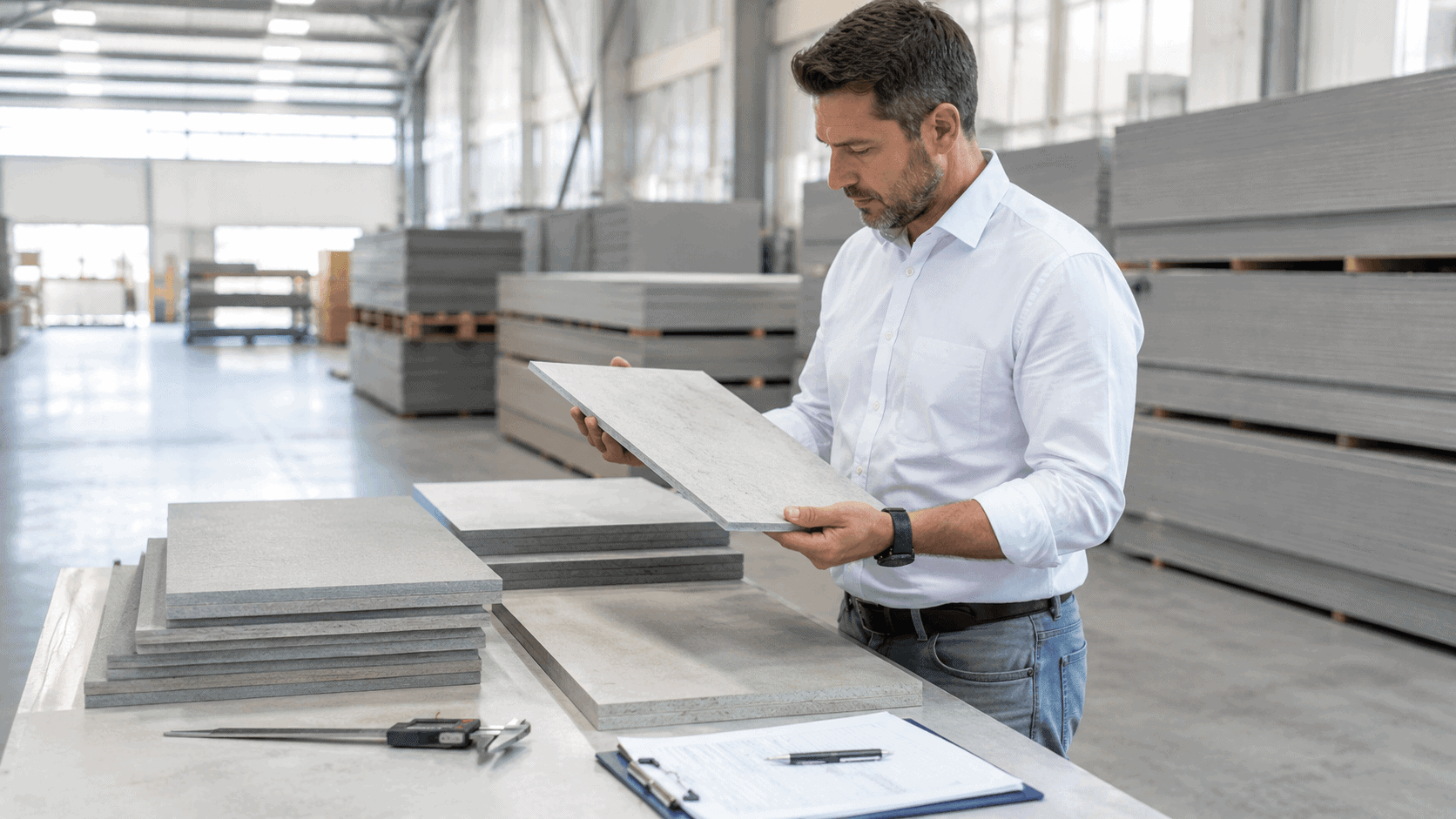
Fiber cement board density is one of the technical values buyers may see on a product datasheet. It is usually shown in kilograms per cubic metre and gives an idea of how much mass the board contains for its volume.
At first, density may look like a simple technical number. In reality, it can affect handling, fixing, cutting, transportation, impact resistance, surface feel, and overall installation confidence.
For contractors, architects, modular builders, façade installers, importers, and procurement teams, understanding fiber cement board density helps make better decisions before ordering or installing the material.
This guide explains what density means, why it matters, and how it should be considered together with board thickness, dimensions, application, and project requirements.
What Does Fiber Cement Board Density Mean?
Density describes how compact or heavy a material is for a given volume. In fiber cement boards, density is usually expressed as kg/m³.
A higher density board contains more mass in the same volume than a lower density board. This can influence the way the board feels, cuts, fixes, and performs during installation.
However, density should not be judged alone. It should always be reviewed together with:
- Board thickness
- Board dimensions
- Bending strength
- Fire rating
- Moisture resistance
- Surface finish
- Intended application
- Fixing method
- Support spacing
- Handling method
- Project environment
A board is not automatically better only because it has a higher density. The best board is the one that fits the application correctly.
Why Density Matters in Fiber Cement Boards
Density affects the practical behaviour of the board on site. It can influence how installers lift the boards, how fixings hold, how cleanly the board cuts, and how stable it feels when mounted.
Density can affect:
- Board weight
- Handling effort
- Cutting resistance
- Screw fixing behaviour
- Edge strength
- Impact resistance
- Surface stability
- Transport planning
- Pallet weight
- Installation speed
- Final wall feel
This is why density is useful not only for engineers, but also for contractors and buyers.
Density and Board Weight
One of the most direct effects of density is weight. A denser board usually feels heavier than a lower-density board of the same thickness and size.
This matters during:
- Manual handling
- Lifting
- Carrying
- Loading
- Unloading
- Site movement
- Scaffold work
- Modular factory production
- Container planning
A heavier board may feel more solid, but it may also require more careful handling and better installation planning.
For large-format boards, even a small difference in thickness or density can affect the total weight of each sheet and pallet.
Density and Thickness Work Together
Density should never be considered without thickness. A thinner high-density board may be lighter than a thicker lower-density board. A thicker board will usually weigh more per sheet, even if the density is similar.
When comparing fiber cement boards, buyers should look at:
- Density
- Thickness
- Width
- Length
- Sheet weight
- Pallet quantity
- Application area
- Support spacing
- Handling equipment
This is especially important for importers, distributors, and modular building manufacturers who need to calculate loading, unloading, and factory workflow.
Density and Handling on Site
Fiber cement boards are often moved several times before installation. They may be handled at the factory, during container loading, at the port, at the warehouse, on the truck, and finally on site.
Density affects how carefully the boards must be handled.
Heavier boards may require:
- More workers for manual carrying
- Better lifting technique
- Proper support across the board length
- Safer pallet handling
- Forklift access
- Stable storage areas
- More attention around corners and edges
Good handling reduces breakage, chipped edges, cracked corners, and surface damage.
Density and Fixing Performance
Fixing performance depends on the complete board system, not density alone. However, density can influence how the board reacts to screws, fasteners, and drilling.
A suitable board should allow clean fixing when the correct screws, edge distances, fixing pattern, and support frame are used.
During fixing, installers should consider:
- Screw type
- Screw length
- Board thickness
- Edge distance
- Support frame type
- Pre-drilling requirements
- Fixing torque
- Board density
- Manufacturer guidance
If a board is too brittle, too soft, too thin, or poorly supported, fixing quality may suffer. Density is one part of this larger picture.
Density and Screw Holding
A board with suitable density can provide a stable fixing surface when installed correctly. However, screw holding is not only about board density.
It also depends on:
- The substrate behind the board
- Whether the fixing goes into steel, timber, or another support
- Screw thread type
- Edge distance
- Screw spacing
- Board thickness
- Whether the board edge is fully supported
- Whether screws are overdriven
Even a strong fiber cement board can crack or loosen if the fixing method is wrong.
Density and Cutting
Density can also affect cutting. Denser boards may feel more resistant during cutting and may require sharper blades, correct tools, and controlled cutting speed.
Clean cutting depends on:
- Correct cutting tool
- Blade quality
- Board support
- Cutting method
- Dust control
- Edge protection
- Installer technique
A good cutting process helps achieve clean edges and reduces waste.
Installers should avoid forcing the tool through the board. A controlled cut usually gives a better result.
Density and Drilling
When drilling fiber cement boards, density may affect how the drill bit enters the surface and how clean the hole appears.
For clean drilling, check:
- Drill bit type
- Drill speed
- Board support
- Edge distance
- Hole diameter
- Avoiding hammer mode
- Dust removal
- Fixing requirements
The correct drilling method helps reduce chipped holes, enlarged openings, and cracks near board edges.
Density and Edge Strength
Board edges are important because many problems start there. Chipped corners, broken edges, rough cuts, and fixing cracks can affect installation quality.
Density can influence edge behaviour, but edge strength also depends on thickness, formulation, handling, cutting quality, and support.
To protect edges:
- Store boards flat
- Lift boards correctly
- Avoid dragging boards
- Support boards during cutting
- Use correct tools
- Avoid impact on corners
- Do not force boards into position
- Keep fixings away from weak edges
- Follow edge distance guidance
Good edge care is essential regardless of density.
Density and Impact Resistance
Fiber cement boards are often selected for durable wall and façade applications. Density may contribute to a stronger, more solid feel, especially when combined with suitable thickness and correct support spacing.
Impact resistance matters in:
- Façades
- External sheathing
- Corridors
- Schools
- Public buildings
- Modular units
- Commercial interiors
- Service areas
- High-traffic zones
However, impact resistance is not only about density. Board thickness, fixing pattern, frame spacing, surface finish, and full wall build-up also matter.
Density and Surface Stability
A board with suitable density and thickness can support a more stable surface. This is important when the final appearance matters.
Surface stability may affect:
- Painted finish quality
- Flatness
- Joint appearance
- Screw head finishing
- Cladding alignment
- Façade appearance
- Interior wall finish
- Modular wall consistency
If the board is not suitable for the application, the finished surface may look uneven or less professional.
Density and Fire Performance
Fiber cement boards are often selected for fire-conscious construction. However, density should not be confused with fire rating.
Fire performance must be checked from the product’s fire classification and, where necessary, the full wall or façade system.
When fire performance matters, check:
- Fire rating
- Standard used
- Board thickness
- Full system build-up
- Fixing method
- Joint treatment
- Cavity barriers
- Local regulation requirements
- Project specification
A dense board is not automatically the same as a fire-rated board. Always check the documented classification.
Density and Moisture Behaviour
Fiber cement boards are commonly used in exterior and moisture-prone applications. Density may influence how solid the board feels, but moisture performance depends on the product composition, manufacturing quality, surface treatment, detailing, and installation.
Moisture-related performance should be considered with:
- Board type
- Edge protection
- Joint detailing
- Ventilation
- Drainage
- Coating system
- Storage conditions
- Exposure time
- Manufacturer guidance
A good fiber cement board should be used as part of a complete, well-detailed wall system.
Density and Transport Planning
Density matters for logistics. Importers, distributors, and contractors should consider density when planning shipments and deliveries.
Higher board weight can affect:
- Pallet weight
- Container loading
- Truck capacity
- Forklift handling
- Warehouse storage
- Manual lifting
- Site delivery
- Crane or hoist planning
Before ordering, buyers should check not only the price per square metre, but also the practical handling and transport requirements.
Density and Container Orders
For full container orders, density can affect the total shipment weight. This is especially important when ordering large quantities or thicker boards.
Before confirming an order, check:
- Board thickness
- Board dimensions
- Sheets per pallet
- Pallet weight
- Number of pallets
- Container weight limits
- Unloading equipment
- Site access
- Warehouse handling capacity
This helps prevent problems after the shipment arrives.
Density and Modular Construction
In modular construction, boards may be installed in a factory, moved through production, transported, lifted, and finally assembled on site.
Density affects modular construction because it can influence:
- Factory handling
- Wall panel weight
- Module weight
- Lifting requirements
- Transport stability
- Fixing confidence
- Edge protection
- Final finish quality
The right board should be selected with the full modular process in mind, not only the wall detail.
Density and Labour Efficiency
A board that is too heavy for the installation team may slow down the work. A board that is too light or unsuitable for the application may not give the required performance.
The best choice is usually a balance between:
- Strength
- Weight
- Workability
- Fixing quality
- Cutting ease
- Handling safety
- Final performance
- Project cost
This is why contractors should review density together with practical site conditions.
Is Higher Density Always Better?
No. Higher density is not always better.
A higher-density board may feel stronger or more solid, but it can also be heavier and more demanding to handle. It may require more careful cutting, lifting, and fixing.
A lower-density board may be easier to handle, but it must still provide the required strength, fire performance, durability, and fixing behaviour for the project.
The right question is not “Which board is densest?”
The better question is:
“Which board has the right density, thickness, strength, fire rating, and handling performance for this application?”
What Density Does Not Tell You
Density is useful, but it does not explain everything. Buyers should not rely on density alone when choosing fiber cement boards.
Density does not fully tell you:
- Fire rating
- Moisture resistance
- Surface quality
- Dimensional stability
- Fixing performance
- Bending strength
- Impact resistance
- Edge durability
- Coating compatibility
- Full system performance
- Long-term façade behaviour
For proper evaluation, density should be read together with the technical datasheet and the application requirements.
What Buyers Should Check on the Datasheet
Before ordering fiber cement boards, buyers should check more than one technical value.
Important points include:
- Density
- Thickness options
- Board dimensions
- Fire classification
- Bending strength
- Moisture-related performance
- Weight per sheet
- Surface finish
- Application guidance
- Fixing recommendations
- Storage instructions
- Cutting and drilling guidance
- Certification documents
This helps avoid choosing a board based only on price or one isolated technical number.
Practical Questions to Ask Before Ordering
Before ordering fiber cement boards, ask:
- What is the board application?
- Is it for interior or exterior use?
- Will it be visible or hidden behind another layer?
- What thickness is required?
- What density is listed on the datasheet?
- What is the sheet weight?
- Can the site team handle the boards safely?
- What fixing method will be used?
- What support frame is planned?
- What fire rating is required?
- Will the board be painted or finished?
- What are the transport and unloading conditions?
- Are technical documents available?
These questions help connect the technical datasheet with real project needs.
Common Mistakes When Comparing Density
Avoid these common mistakes:
- Choosing only the highest density
- Ignoring board thickness
- Comparing boards of different dimensions unfairly
- Forgetting pallet and container weight
- Ignoring handling safety
- Assuming density equals fire rating
- Assuming density equals moisture resistance
- Ignoring support spacing
- Ignoring fixing method
- Choosing only by price per square metre
- Forgetting the full wall system
- Not checking technical documents before ordering
A good comparison should be practical, not just numerical.
Density Comparison Checklist
When comparing fiber cement boards, check:
- Is the density clearly stated?
- Are board dimensions clearly stated?
- Is the thickness suitable for the application?
- Is the fire rating documented?
- Is the bending strength suitable?
- Is the board weight practical for handling?
- Is the fixing method clear?
- Is the surface suitable for the final finish?
- Is the board suitable for the project environment?
- Are storage and transport requirements understood?
- Are technical documents available before order confirmation?
This checklist helps buyers make more confident decisions.
Final Thoughts
Fiber cement board density is an important technical value, but it should not be read in isolation. It affects weight, handling, cutting, fixing, transport, and installation planning. However, it must always be considered together with board thickness, dimensions, fire rating, bending strength, fixing method, and project application.
For contractors, architects, modular builders, façade installers, importers, and procurement teams, density helps answer practical questions before the boards arrive on site.
The best fiber cement board is not simply the densest board. It is the board that offers the right balance of strength, weight, workability, fire performance, durability, and installation confidence for the specific project.
Need pricing, technical documents, or loading guidance for fiber cement boards? Contact Smartcon with your required thickness, dimensions, quantity, and delivery destination. Our team will help you review the suitable options and provide practical export support from Turkey.
👉 Visit the Smartfiber Fiber Cement Board page to explore specs, sizes, and delivery options.
Authored by Smartcon Int’l. Trade & Marketing Ltd. on 15.06.2026. All rights reserved.
Façade specification
Need the right board for your façade system?
Share the façade build-up, exposure conditions, finish and documentation requirements. We can help assess the appropriate board and coordinate supply.