
Blog
Fiber Cement Board Behind Render: What Specifiers Should Know
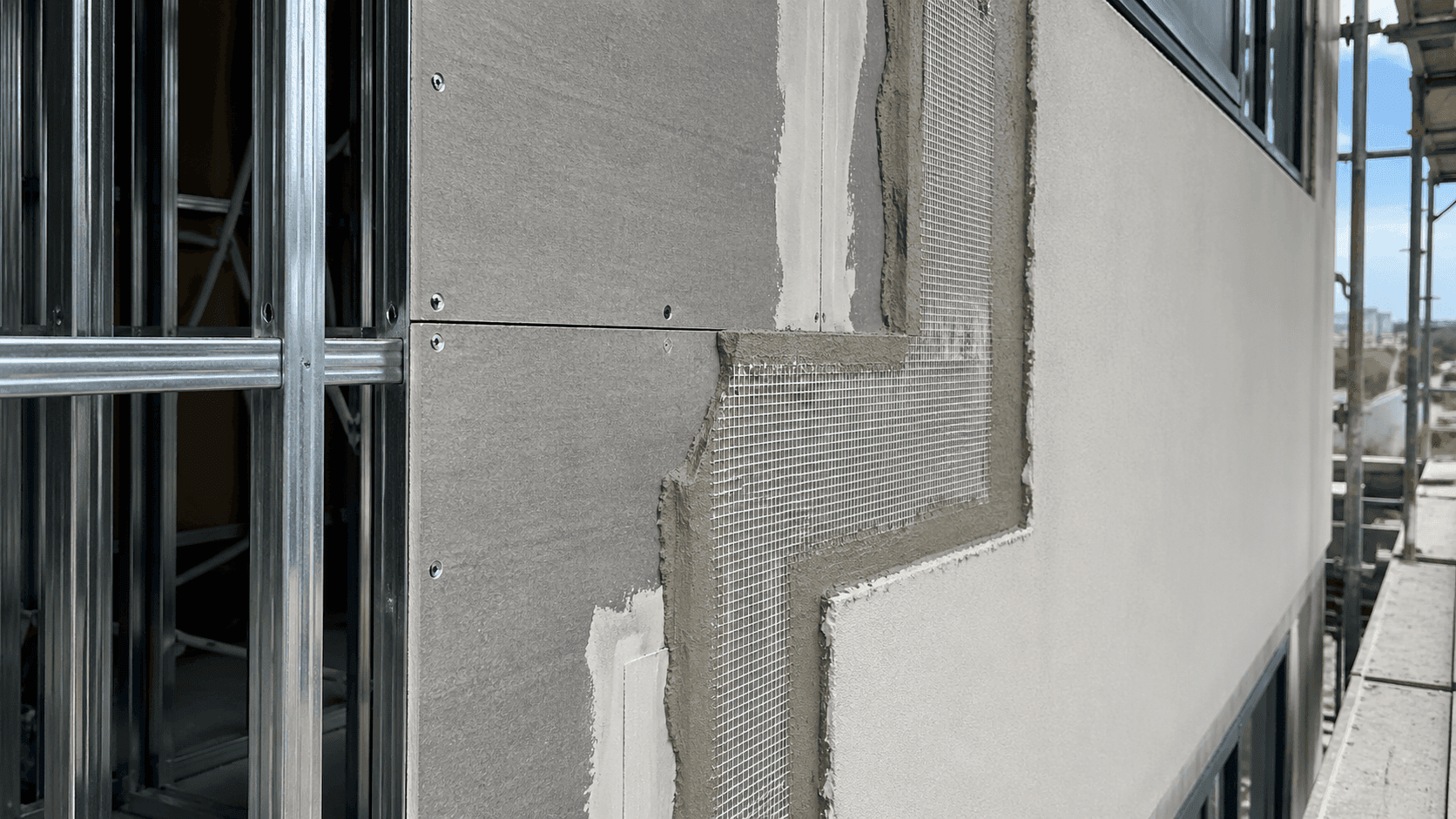
Fiber cement board can be used behind render in selected wall and façade systems. However, it should not be treated as a simple “fix and render” material without checking the full system.
The board, fixings, joints, primer, mesh, base coat, render finish, and support structure must work together. If one part of the system is wrong, the final surface may crack, move, or fail earlier than expected.
For architects, contractors, developers, and specifiers, the key point is simple: fiber cement board behind render can be a reliable solution when the system is designed and installed correctly.
This guide explains what to check before specifying fiber cement boards behind render.
Why Use Fiber Cement Board Behind Render?
Fiber cement boards are often chosen as a backing or substrate board because they are stable, durable, and suitable for modern dry construction systems.
They can be used behind render in applications such as:
- External wall systems
- Lightweight steel frame buildings
- Modular construction
- Prefabricated wall panels
- Rainscreen and façade build-ups
- Dry construction façades
- Renovation projects
The board provides a flat and practical surface for the next layers of the wall system. It can also help create a more consistent substrate than uneven masonry or mixed existing surfaces.
However, render performance depends on more than the board itself.
Can You Render Directly Onto Fiber Cement Board?
In many cases, render should not be applied directly onto bare fiber cement board without a compatible system.
The correct approach usually includes:
- Suitable board fixing
- Correct joint gaps
- Joint treatment
- Primer or bonding layer
- Reinforcement mesh
- Base coat
- Compatible render finish
The exact build-up depends on the render manufacturer, project location, exposure level, and required finish.
Before specifying the system, always check whether the render system is approved or recommended for use over fiber cement board.
Why System Compatibility Matters
Fiber cement board and render can both perform well, but they behave differently.
Boards may move slightly because of temperature, moisture, support movement, or normal building movement. Render layers must be able to handle this movement without cracking.
System compatibility matters because it affects:
- Adhesion
- Crack resistance
- Moisture control
- Surface flatness
- Long-term durability
- Fire performance
- Weather resistance
A good specification should not only say “fiber cement board behind render.” It should describe the full system.
Check the Board Thickness
Board thickness is important when fiber cement board is used behind render.
The board must be thick enough to provide a stable backing surface. If the board is too thin for the support spacing or exposure level, it may flex or move.
That movement can transfer into the render layer.
For external wall and façade applications, 8mm and 10mm fiber cement boards are commonly used. In more demanding areas, thicker boards may be needed.
The final choice should depend on:
- Support spacing
- Building height
- Wind exposure
- Impact risk
- Render system weight
- Fixing method
- Manufacturer guidance
Do not choose board thickness based on price alone. The render finish depends on the stability of the substrate behind it.
Support Structure Must Be Flat and Stable
A rendered board system needs a flat and stable support structure.
If the frame is uneven, the boards may not sit correctly. This can lead to visible waves, uneven render thickness, joint stress, or cracking.
Before board installation, check:
- Stud alignment
- Batten spacing
- Frame level
- Fixing points
- Deflection risk
- Moisture condition of timber supports
- Corrosion protection of metal supports
The render finish will only be as good as the surface behind it.
Fixing Method Is Critical
Fiber cement boards behind render must be fixed correctly.
Poor fixing can cause movement, vibration, or stress at board edges. These problems may appear later as cracks in the render.
Check the following before installation:
- Correct screw type
- Correct screw spacing
- Correct edge distance
- Proper screw head position
- No overdriving of screws
- No unsupported board edges
- Fixing into a suitable support structure
Screws should hold the board firmly without damaging the surface. Overdriven screws can weaken the board and create local stress points.
Leave the Correct Joint Gaps
Joint gaps are important when using fiber cement board behind render.
Boards should not be pushed tightly together. They need space for small movements. If the boards are installed too tightly, pressure can build up between them.
This may cause:
- Board edge damage
- Surface stress
- Cracking above joints
- Uneven render finish
- Premature failure
Joint gap requirements can vary by board type and system. Always follow the manufacturer’s installation guidance.
Treat Joints Carefully
Joints are one of the most important parts of a rendered fiber cement board system.
Even if the board surface is strong, untreated or poorly treated joints can become weak points.
A good joint treatment system may include:
- Correct joint gap
- Suitable joint filler or sealant
- Reinforcement tape or mesh
- Base coat layer
- Full-surface mesh reinforcement
The joint treatment must be compatible with both the board and the render system.
Do not treat board joints as a minor detail. Many render problems start at the joints.
Use Primer or Bonding Layer When Required
Fiber cement boards may require a primer or bonding layer before the render system is applied.
Primer can help improve:
- Adhesion
- Surface consistency
- Suction control
- Dust binding
- Compatibility between layers
Skipping primer may lead to weak bonding, uneven drying, or poor surface performance.
The correct primer should be selected according to the render system supplier’s recommendation.
Reinforcement Mesh Helps Reduce Cracking Risk
Reinforcement mesh is commonly used in rendered board systems.
It helps distribute stress across the surface and reduces the risk of cracking. This is especially important at board joints, corners, openings, and transition areas.
Mesh is often embedded into the base coat before the final render finish.
Important areas for reinforcement include:
- Board joints
- External corners
- Internal corners
- Window openings
- Door openings
- Service penetrations
- Base of wall
- Material transitions
Mesh does not fix poor installation. It supports a correctly designed system.
Pay Attention to Windows, Doors, and Openings
Openings are high-risk areas in rendered façade systems.
Cracks often appear around window and door corners because these areas concentrate movement and stress.
When specifying fiber cement board behind render, check that the system includes proper detailing around:
- Window reveals
- Door openings
- Lintels
- Sills
- External corners
- Internal corners
- Junctions with other materials
Diagonal mesh reinforcement may be needed around opening corners, depending on the render system.
These small details can make a major difference in long-term performance.
Moisture Control Is Essential
Fiber cement board performs well in moisture-exposed construction areas, but the full wall system still needs proper moisture control.
A rendered façade must be designed to manage rain, vapour, condensation, drainage, and drying.
Specifiers should check:
- Weather barrier requirements
- Breather membrane position
- Ventilation needs
- Drainage paths
- Sealant details
- Flashings
- Base-of-wall protection
- Window and door sealing
Render should not be relied on as the only protection against water. The complete wall system must be designed correctly.
Do Not Ignore Movement
All building materials move to some degree.
Fiber cement boards, support frames, render layers, sealants, and insulation materials may all respond differently to temperature, moisture, and structural movement.
Movement joints may be required in larger wall areas or at structural junctions.
Check movement requirements at:
- Long wall elevations
- Floor lines
- Structural joints
- Corners
- Material changes
- Openings
- Large uninterrupted rendered areas
Ignoring movement is one of the common causes of cracking in rendered systems.
Common Mistakes to Avoid
When using fiber cement board behind render, avoid these common mistakes:
- Applying render directly without checking compatibility
- Using the wrong board thickness
- Installing boards over an uneven frame
- Fixing boards with incorrect screw spacing
- Overdriving screw heads
- Ignoring joint gaps
- Leaving joints untreated
- Skipping primer when required
- Using incompatible filler, mesh, or render products
- Forgetting reinforcement around openings
- Ignoring moisture control details
- Treating render as a way to hide poor board installation
A rendered finish can only perform well when the board installation underneath is correct.
What Specifiers Should Include in the Specification
A good specification should clearly define the full wall system.
It should include:
- Fiber cement board type and thickness
- Board size
- Support structure
- Fixing type and spacing
- Edge distance
- Joint gap requirements
- Joint treatment method
- Primer or bonding layer
- Reinforcement mesh
- Base coat
- Render finish
- Movement joint requirements
- Moisture control layers
- Opening and corner details
- Manufacturer installation instructions
This helps reduce confusion between designers, contractors, installers, and suppliers.
Clear specifications also reduce site mistakes.
When Fiber Cement Board Behind Render Works Best
Fiber cement board behind render works best when:
- The support structure is flat and stable
- The correct board thickness is selected
- Boards are fixed properly
- Joint gaps are respected
- Joints are reinforced
- Compatible primer and render systems are used
- Moisture and movement details are planned
- Installation guidance is followed
In these conditions, fiber cement board can provide a strong and practical substrate for rendered wall systems.
Final Thoughts
Fiber cement board behind render can be a dependable solution for modern construction. It is especially useful in lightweight steel frame, modular, prefabricated, and dry construction systems.
However, the final performance depends on the complete system, not only the board.
Specifiers should check board thickness, fixing method, joint treatment, primer, mesh, render compatibility, moisture control, and movement details before approving the build-up.
When these points are handled correctly, fiber cement boards can provide a stable and reliable base for rendered façade and wall systems.
Before choosing a board behind render, it is useful to understand how fiber cement board differs from cement particle board in composition, fire performance, moisture behavior, and exterior use.
👉 Visit the Smartfiber Fiber Cement Board page to explore specs, sizes, and delivery options.
Authored by Smartcon Int’l. Trade & Marketing Ltd. on 30.04.2026. All rights reserved.
Façade specification
Need the right board for your façade system?
Share the façade build-up, exposure conditions, finish and documentation requirements. We can help assess the appropriate board and coordinate supply.