
Blog
Fiber Cement Board Behind Brick Slips, Stone, and Rendered Finishes: What to Check
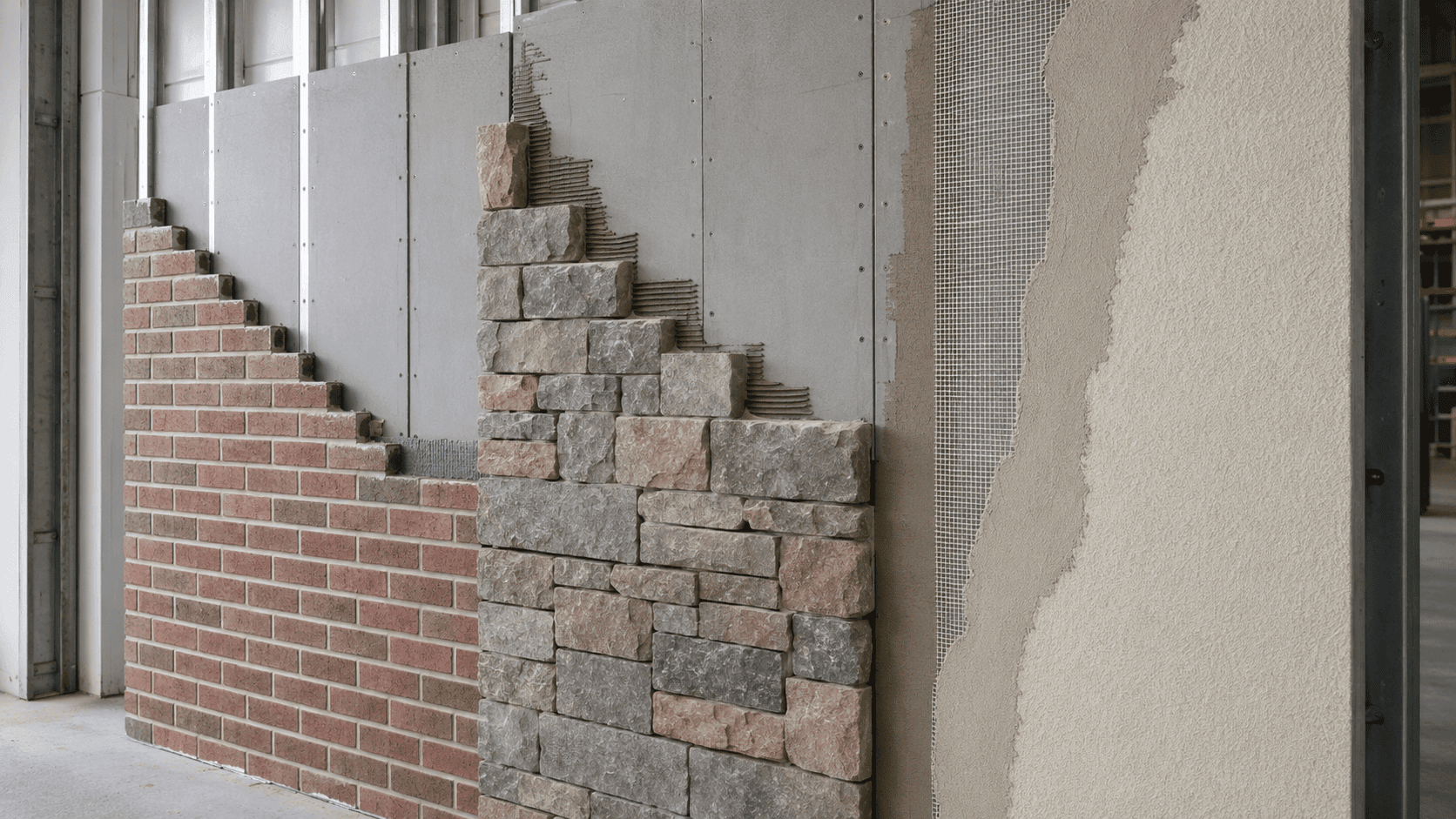
Fiber cement board can be used as a substrate behind brick slips, stone finishes, and rendered wall systems in selected construction applications.
However, the board should not be treated as a universal backing board for every finish without checking the complete system.
Brick slips, stone cladding, and render all place different demands on the substrate. They may require different adhesives, primers, fixings, joint treatments, reinforcement layers, moisture control details, and support structures.
For architects, contractors, developers, and specifiers, the key point is simple: fiber cement board can provide a stable and practical backing surface, but the full wall build-up must be compatible with the chosen finish.
This guide explains what to check before using fiber cement board behind decorative wall and façade finishes.
Why Fiber Cement Board Is Used Behind Decorative Finishes
Fiber cement boards are commonly used in modern wall and façade systems because they are durable, stable, and suitable for dry construction.
They can provide a flat backing surface behind different finishes, such as:
- Brick slips
- Stone cladding
- Render systems
- Lightweight façade finishes
- Decorative wall panels
- Tile-like exterior finishes
- Internal feature walls
- External sheathing systems
This makes fiber cement board useful in modular construction, lightweight steel frame systems, timber frame buildings, renovation projects, and façade applications.
But the final finish must be selected and installed correctly.
The Finish Determines the System
The most important rule is this: the finish determines the system.
A wall behind brick slips is not exactly the same as a wall behind stone cladding. A rendered façade also has different requirements.
Each finish affects:
- Board thickness
- Support spacing
- Adhesive type
- Primer requirement
- Joint treatment
- Reinforcement needs
- Moisture protection
- Movement joints
- Final weight on the wall
- Long-term maintenance
This is why specifiers should avoid vague descriptions such as “fiber cement board behind finish.”
The correct specification should describe the complete build-up.
Check the Weight of the Final Finish
Brick slips, stone, and render do not have the same weight.
Some brick slips are relatively light. Some stone finishes can be much heavier. Render systems may be lighter than stone, but they still add surface load and movement considerations.
Before specifying the board, check:
- Weight of the finish
- Adhesive or mortar weight
- Base coat weight
- Reinforcement layer
- Support frame capacity
- Fixing performance
- Board thickness
- Building height
- Exposure level
A board that works well behind a light render finish may not automatically be suitable behind heavier stone cladding.
The full wall system must be designed for the final load.
Board Thickness Matters
Fiber cement board thickness should be selected according to the application and finish.
For many wall and façade applications, 8mm and 10mm boards are commonly used. However, heavier finishes or more demanding systems may require thicker boards or closer support spacing.
Thickness selection depends on:
- Final finish weight
- Support spacing
- Impact risk
- Wind exposure
- Board size
- Fixing method
- External or internal use
- Manufacturer guidance
Do not choose the board thickness only by price. The substrate must be stable enough for the finish applied over it.
The Support Frame Must Be Stable
A decorative finish can only perform well if the substrate behind it is stable.
The fiber cement board must be fixed to a suitable support frame. This may be:
- Steel frame
- Timber frame
- Metal studs
- Timber battens
- Façade rails
- Modular wall frame
- Existing wall structure with suitable support
The frame should be flat, aligned, strong, and compatible with the full system.
If the frame moves, twists, or deflects, the finish may crack, debond, or look uneven.
This is especially important for stone and render finishes because surface defects can become highly visible.
Fixing the Fiber Cement Board Correctly
Before applying any finish, the fiber cement board must be fixed correctly.
Poor fixing can cause movement in the substrate. This movement can transfer into the final finish.
Check the following:
- Correct screw type
- Correct screw spacing
- Correct edge distance
- Proper screw head position
- Full edge support
- No overdriven screws
- No loose boards
- No unsupported board joints
- Correct board orientation where required
The board should feel stable before the decorative finish is applied.
If the board moves, the finish is already at risk.
Joint Gaps Must Be Planned
Fiber cement boards should not usually be installed tightly against each other without a joint gap.
Boards need space for small movements caused by moisture, temperature, and normal building movement.
If joint gaps are ignored, pressure can build up between boards.
This can lead to:
- Cracking
- Edge damage
- Surface stress
- Uneven finish
- Failure around joints
- Poor long-term appearance
Joint gap requirements depend on the board, finish, and wall system. Always follow the relevant installation guidance.
Joint Treatment Is Critical
Joints are one of the most important details when fiber cement board is used behind brick slips, stone, or render.
A poorly treated joint can become a weak point.
Joint treatment may involve:
- Correct joint gap
- Compatible filler or sealant
- Reinforcement tape
- Mesh reinforcement
- Base coat layer
- Movement joint planning
- Finish-specific joint detailing
The correct method depends on the finish.
A joint detail behind render may not be the same as a joint detail behind brick slips or stone.
Using Fiber Cement Board Behind Brick Slips
Fiber cement board can be used behind brick slips in selected systems, but the adhesive and board preparation must be compatible.
Brick slips create a finished masonry appearance without the full thickness of traditional brickwork. They are often used in lightweight construction, renovation, modular projects, and façade systems.
Before installing brick slips over fiber cement board, check:
- Board thickness
- Board fixing stability
- Surface cleanliness
- Primer requirement
- Adhesive compatibility
- Slip weight
- Jointing method
- Movement joints
- External weather exposure
- Manufacturer approval
The adhesive must be suitable for both the brick slips and the fiber cement board surface.
Do not assume every tile adhesive or mortar is suitable.
Brick Slip Adhesion: What to Check
Adhesion is a key concern with brick slips.
The bond between the board, primer, adhesive, and brick slip must be strong enough for the application.
Before installation, check:
- Is the board surface clean and dust-free?
- Is primer required?
- Is the adhesive suitable for fiber cement board?
- Is the adhesive suitable for external use?
- Is the adhesive suitable for the weight of the slips?
- Are movement joints included?
- Is the system suitable for freeze-thaw exposure where relevant?
- Is the background stable enough?
Good adhesion depends on the full system, not only the adhesive.
Using Fiber Cement Board Behind Stone Cladding
Stone finishes require extra care because they can be heavier than render or brick slips.
Natural stone, reconstructed stone, and stone-effect cladding systems may all have different weight and fixing requirements.
Before using fiber cement board behind stone, check:
- Stone weight
- Adhesive or mechanical fixing method
- Board thickness
- Support frame capacity
- Fixing centres
- Moisture exposure
- Movement joints
- Manufacturer guidance
- External wall design
- Safety requirements
For heavier stone systems, mechanical support or a dedicated cladding system may be required.
A fiber cement board should not be expected to carry heavy finishes unless the full system is designed for it.
Stone Cladding: Do Not Rely Only on Adhesive
For some stone finishes, adhesive alone may not be enough.
Depending on the weight, height, and exposure of the installation, additional mechanical support may be needed.
This may include:
- Support rails
- Mechanical anchors
- Clips
- Brackets
- Starter profiles
- Load-bearing ledges
- Dedicated stone cladding systems
This is especially important in external façades.
Specifiers should check whether the stone system is designed as a bonded finish, mechanically fixed finish, or a combined system.
Using Fiber Cement Board Behind Rendered Finishes
Fiber cement board can be used behind render in selected wall systems when the render system is compatible.
Render should not simply be applied directly to a board without checking the required build-up.
A rendered system may need:
- Primer
- Joint treatment
- Base coat
- Reinforcement mesh
- Compatible render finish
- Movement joints
- Moisture control layers
- Corner reinforcement
- Opening details
Render can crack if the board moves, the joints are untreated, or the system is not reinforced properly.
The board must be stable, clean, and correctly fixed before render application.
Render Needs Reinforcement
Rendered board systems often require reinforcement mesh.
Mesh helps distribute surface stress and reduce the risk of cracking.
Important areas for reinforcement include:
- Board joints
- Window corners
- Door corners
- Service penetrations
- External corners
- Internal corners
- Material transitions
- Base of wall
Mesh does not fix a poor substrate. It supports a properly installed system.
If the board installation is weak, the render may still fail.
Surface Preparation Before Finishing
Before brick slips, stone, or render are applied, the board surface should be prepared properly.
Surface preparation may include:
- Dust removal
- Cleaning dirt or site contamination
- Checking for moisture
- Removing loose particles
- Applying primer where required
- Checking screw heads
- Inspecting board joints
- Confirming surface flatness
Do not apply finishes over dirty, wet, dusty, or unstable boards.
Poor surface preparation can cause adhesion problems and uneven finishing.
Moisture Control Behind Decorative Finishes
Moisture control is important in all external wall systems.
Brick slips, stone, and render may reduce direct exposure to the board surface, but they do not remove the need for correct moisture detailing.
Check:
- Breather membrane requirements
- Cavity design
- Drainage paths
- Flashings
- Base details
- Window and door sealing
- Service penetrations
- Ventilation requirements
- Weather exposure
- Sealant compatibility
The wall must be able to manage moisture safely.
Do not rely only on the decorative finish as the weather protection layer unless the system is designed that way.
Movement Joints Must Not Be Ignored
Movement joints are important in wall and façade systems.
Fiber cement boards, support frames, adhesives, render, brick slips, and stone finishes can all move differently.
Movement can come from:
- Temperature change
- Moisture variation
- Building movement
- Frame movement
- Material expansion
- Structural joints
- Long wall elevations
If movement is ignored, cracks may appear in the finish.
Movement joints should be planned before work starts, not added after cracks appear.
Openings and Corners Need Extra Attention
Windows, doors, corners, and service penetrations are common weak points.
These areas may need special reinforcement, sealing, flashing, or movement detailing.
Check details around:
- Window reveals
- Door thresholds
- External corners
- Internal corners
- Pipe penetrations
- Cable openings
- Ventilation outlets
- Base of wall
- Junctions with other materials
Decorative finishes often fail first at these areas because stress and moisture are concentrated there.
Internal vs External Applications
Internal and external applications are not the same.
An internal feature wall with brick slips is usually less exposed than an external façade.
External applications must consider:
- Rain exposure
- Wind
- UV exposure
- Freeze-thaw risk
- Drainage
- Movement
- Fire requirements
- Maintenance access
- Long-term weathering
Internal applications still need good fixing and surface preparation, but external applications require more careful detailing.
Fire Performance Considerations
Fiber cement boards are often selected for fire-safe construction.
However, the fire performance of the full system depends on every layer.
When using brick slips, stone, or render over fiber cement board, check:
- Board fire classification
- Adhesive fire performance
- Finish material
- Cavity barriers
- Insulation
- Membranes
- Sealants
- Fixings
- Local regulations
- Full system classification
Do not assume the complete wall system has the same fire performance as one individual material.
Common Mistakes to Avoid
Avoid these common mistakes when using fiber cement board behind brick slips, stone, or render:
- Applying finishes without checking system compatibility
- Using the wrong board thickness
- Fixing boards to an uneven support frame
- Ignoring board joint gaps
- Treating joints incorrectly
- Applying adhesive over dusty boards
- Using the wrong primer
- Using adhesive not suitable for external use
- Ignoring the weight of stone finishes
- Relying only on adhesive for heavy cladding
- Forgetting movement joints
- Ignoring moisture control
- Skipping mesh in rendered systems
- Poor detailing around windows, doors, and penetrations
- Assuming the board alone guarantees full system performance
Most failures happen because the system was not considered as a whole.
Specifier Checklist Before Approval
Before specifying fiber cement board behind decorative finishes, check the following:
- What finish will be applied?
- Is the finish internal or external?
- What is the weight of the finish?
- Is the board thickness suitable?
- Is the support frame stable?
- Are fixing centres correct?
- Are board joints supported?
- Is joint treatment specified?
- Is primer required?
- Is the adhesive compatible?
- Is reinforcement mesh required?
- Are movement joints included?
- Is moisture control detailed?
- Are openings and corners reinforced?
- Is fire performance checked as a full system?
- Are manufacturer recommendations followed?
This checklist helps reduce risk before installation starts.
When This System Works Best
Fiber cement board behind brick slips, stone, or render works best when:
- The board is correctly selected
- The support frame is flat and stable
- The board is fixed properly
- The finish weight is suitable
- Adhesives and primers are compatible
- Joints are treated correctly
- Moisture control is planned
- Movement joints are included
- Details around openings are reinforced
- Installation guidance is followed
In these conditions, fiber cement board can provide a reliable substrate for many decorative wall and façade finishes.
Final Thoughts
Fiber cement board can be a practical and dependable substrate behind brick slips, stone cladding, and rendered finishes. However, the success of the system depends on compatibility.
The board, support frame, fixings, joints, primer, adhesive, mesh, moisture control layers, and final finish must all work together.For specifiers, the safest approach is to think in terms of the full wall system, not just the board.
When the correct details are used, fiber cement boards can support clean, durable, and professional wall finishes in modern construction.
Need pricing, technical documents, or loading guidance for fiber cement boards? Contact Smartcon with your required thickness, dimensions, quantity, and delivery destination. Our team will help you review the suitable options and provide practical export support from Turkey.
👉 Visit the Smartfiber Fiber Cement Board page to explore specs, sizes, and delivery options.
Authored by Smartcon Int’l. Trade & Marketing Ltd. on 08.05.2026. All rights reserved.
Façade specification
Planning a brick-lined façade?
Share the façade geometry, brick appearance and installation requirements. We can help assess the lining-panel approach and coordinate the next steps.