
Blog
Fire Rating Requirements for Exterior Sheathing Boards in High-Rise Buildings
Introduction
High-rise façades are scrutinized for fire performance because flame spread on the exterior envelope can endanger occupants and compromise structural integrity. Exterior sheathing boards are a critical layer in that envelope. Meeting fire requirements is not just about a “good material”; it’s about system performance—board + insulation + air cavity + subframe + cladding + fixings + membranes.
Reaction to Fire vs. Fire Resistance
Before specifying, distinguish two regulatory concepts:
- Reaction to Fire (material behavior at ignition/early growth): measures combustibility, flame spread, smoke, and droplets.
- Fire Resistance (assembly performance over time): stability, integrity, and insulation for a rated duration (e.g., 30/60/90 minutes).
Exterior sheathing boards typically contribute to reaction to fire requirements as a non-combustible or limited-combustibility layer, and may also form part of fire-resisting wall assemblies when tested with framing and insulation.
Core Material-Level Classifications
Depending on jurisdiction, sheathing boards are commonly expected to achieve:
- EN 13501-1 (EU/UK): Class A1 (non-combustible) or A2-s1,d0 (very limited combustibility, low smoke, no flaming droplets) for façade applications.
- ASTM E84 / UL 723 (US): Class A (FSI ≤ 25; SDI ≤ 450) surface burning characteristics.
- ISO 1182 / ISO 1716: Non-combustibility and calorific value checks used to support A1/A2 classification data.
Most exterior-grade fiber cement or cementitious sheathing boards achieve A1/A2 (or Class A) when tested as materials.
System-Level Façade Tests (High-Rise Critical)
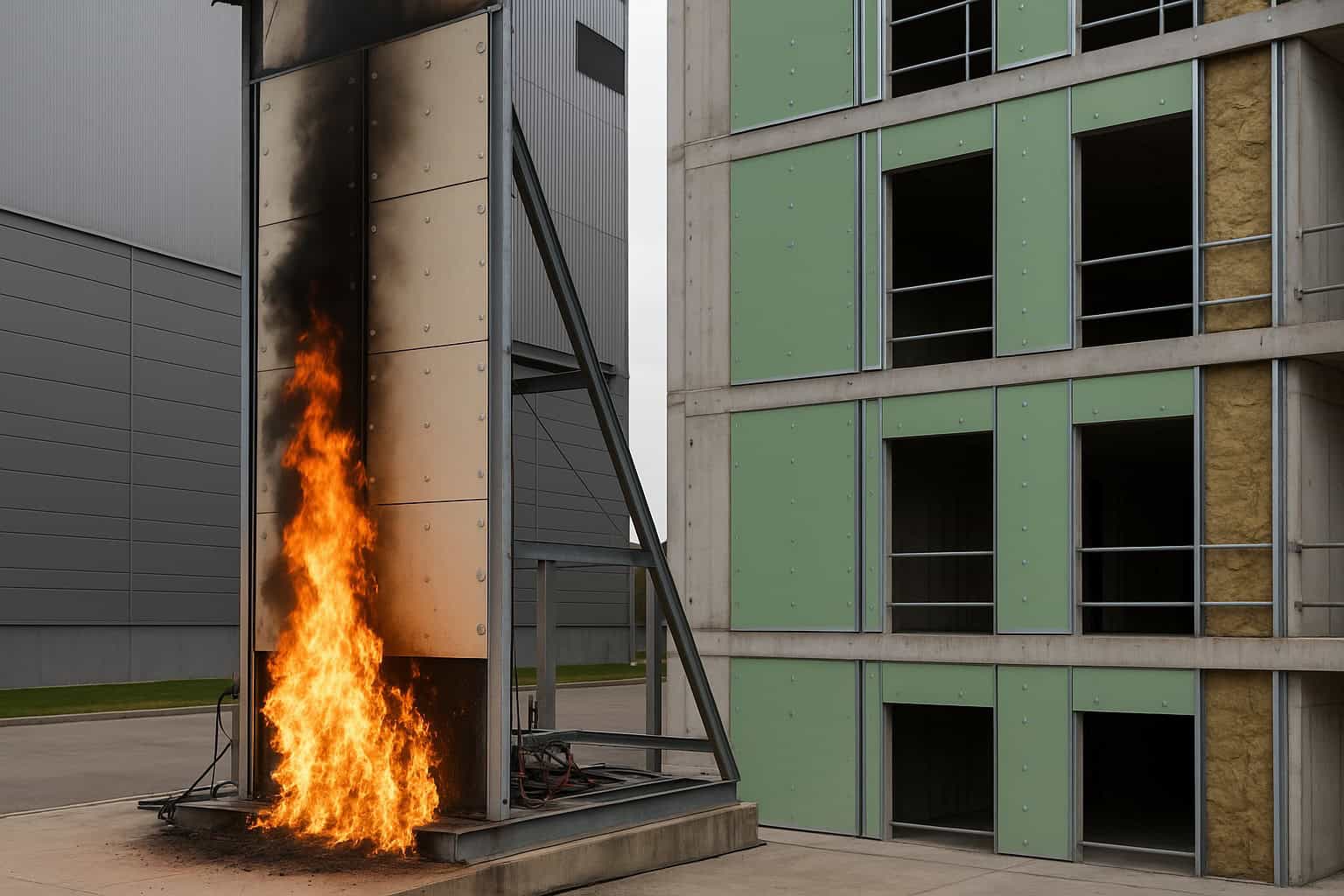
High-rise requirements focus on full façade system fire behavior—not just individual components:
- NFPA 285 (US): Evaluates vertical and lateral flame propagation of wall assemblies containing combustible components. Passing NFPA 285 with the intended sheathing, insulation, cladding, and air/water barrier is often mandatory for multi-storey buildings.
- BS 8414-1/-2 (UK & many markets): Large-scale system test for external cladding systems on a full-height rig; results are classified via BR 135 assessment.
- EN 1364-1 / EN 1365 (EU): Fire resistance tests for non-loadbearing and loadbearing walls (EI/EW classifications).
- ASTM E119 (US): Assembly fire resistance rating, used when the exterior wall requires a time rating.
- AS 5113 (Australia/NZ): Full-scale façade fire propagation test.
Key takeaway: If the high-rise envelope includes any combustible layers (e.g., membranes, some insulations, coatings), authorities typically require a passed system test (NFPA 285 or BS 8414/BR 135, etc.) that includes the same sheathing board model and fixings.
What Specifiers Must Verify and Document
1-Material Classification for the Board
- Certificate and test report showing EN 13501-1 A1/A2-s1,d0 (or ASTM E84 Class A).
- Harmonized product standard compliance (e.g., EN 12467 for fiber-cement sheets) with DoP/CE or UKCA documentation.
2-Façade System Evidence
- Exact assembly tested to NFPA 285 or BS 8414 (or local equivalent), with:
- same sheathing thickness and grade
- same subframe (steel/aluminium/timber), cavity depth, and fire barriers
- same insulation type (e.g., mineral wool vs PIR) and density
- same weather/air barrier and cladding type.
3-Fire-Stopping and Compartmentation Details
- Horizontal and vertical cavity barriers around floor lines, openings, and module joints (for modular buildings).
- Continuity of firestops across module interfaces.
4-Installation Controls
- Fastener type/spacing, joint gaps, sealed penetrations, and edge distances per the fire-tested specification.
- No site substitutions without a formal engineering judgment or additional test evidence.
Typical High-Rise Expectations by Application
- Rainscreen/ventilated façades: A1/A2 sheathing; façade system to BS 8414/BR 135 (UK) or NFPA 285 (US). Mineral wool insulation is commonly paired to reduce system risk.
- Curtain wall backup walls: Non-combustible sheathing (A1/A2/Class A) plus tested E119/EN 1364 wall ratings where required near lot lines.
- Modular high-rise: Same evidence as above, plus proof of fire barrier continuity across module seams.
Common Pitfalls That Lead to Rejections
- Assuming a board’s A1/A2/Class A classification is sufficient without system testing.
- Swapping to different air/water barriers, adhesives, or insulation not included in the passing assembly.
- Unsealed service penetrations and omitted cavity barriers.
- Using untested fasteners or spacing that alter heat transfer and joint behavior.
Conclusion
For high-rise buildings, the exterior sheathing board fire rating must be proven at both the material level (A1/A2/Class A) and, crucially, at the façade system level through large-scale tests like NFPA 285 or BS 8414/BR 135. Selecting a non-combustible, cementitious sheathing board is the right starting point, but compliance depends on evidence for the complete wall assembly, installed exactly as tested.
If you share your target market (UK, EU, US, GCC), I can adapt this to the precise local code pathway and produce a submittal checklist you can hand to clients and inspectors.
For high-performance sheathing that is engineered to withstand moisture and enhance façade systems, explore the Smartcon Exterior Sheathing Board.
Authored by Smartcon Int’l. Trade & Marketing Ltd. on 19.10.2025. All rights reserved.
Exterior wall system
Specifying an exterior wall system?
Share the wall build-up, exposure, framing and fire-performance requirements. We can help assess the sheathing specification and next steps.